
Reduce Carbon Footprint in Industry
In this article
- Where do industrial carbon emissions come from?
- Why is it so hard to reduce the carbon footprint in industry?
- Why GCC manufacturers need to reduce the carbon footprint in industry?
- 9 Practical Steps to Reduce Carbon Footprint in Industry
- 7 Mistakes That Stall Efforts to Reduce Carbon Footprint in Industry
- How Octscope Helps Reduce Carbon Footprint in Industry
- Conclusion
You can’t reduce what you can’t trace.
Start with the product data you already have.
Reducing the carbon footprint in industry is based on knowing the sources of the emissions and how much each product emits. Manufacturers have to quantify the amount of emissions for each product in order to determine where carbon reduction should occur.
This is especially important for manufacturers in the Gulf countries looking to reduce carbon footprint in their industries, driven by increasing demands from customers, tenders, audits, and export markets for information about product emissions.
Establishing an accurate product carbon footprint baseline helps manufacturers make informed decisions based on actual emission contributions rather than assumptions. It also helps them identify which materials, processes, or activities need the most attention.
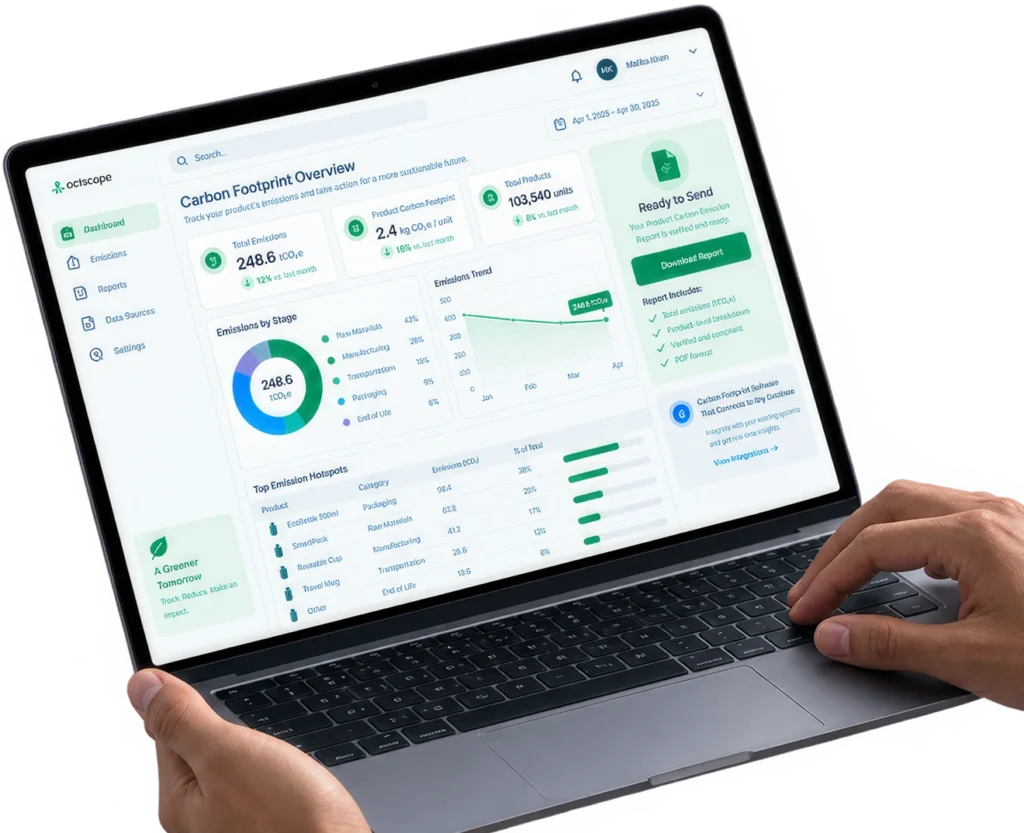
We, at Octscope, work to help manufacturers collect data on materials, sourcing, manufacturing location, and transportation in order to calculate their PCF and provide a Product Carbon Emission Report.
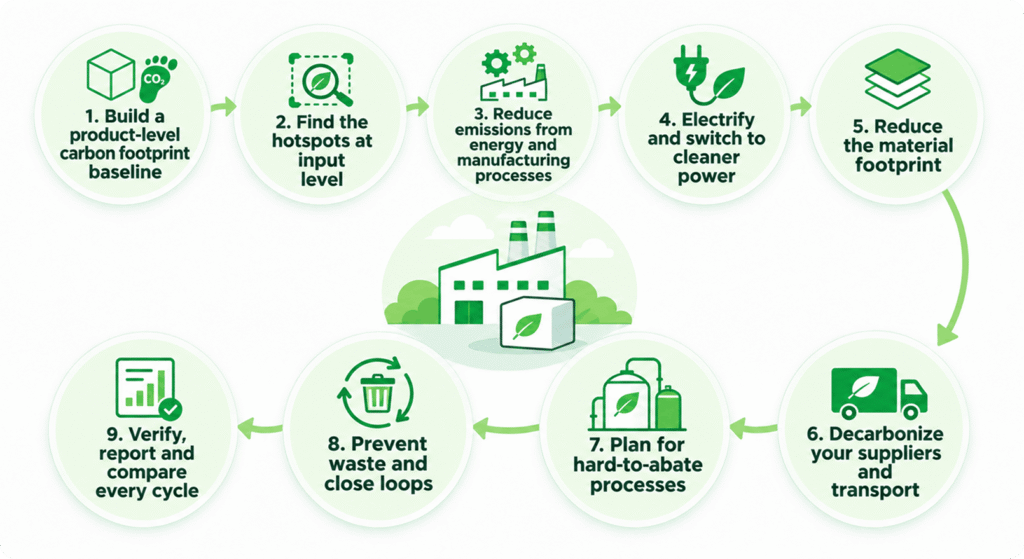
Here is a list of nine steps for manufacturers to build a baseline of their PCF, pinpoint significant emissions sources, and decrease emissions from their products.
Where do industrial carbon emissions come from?
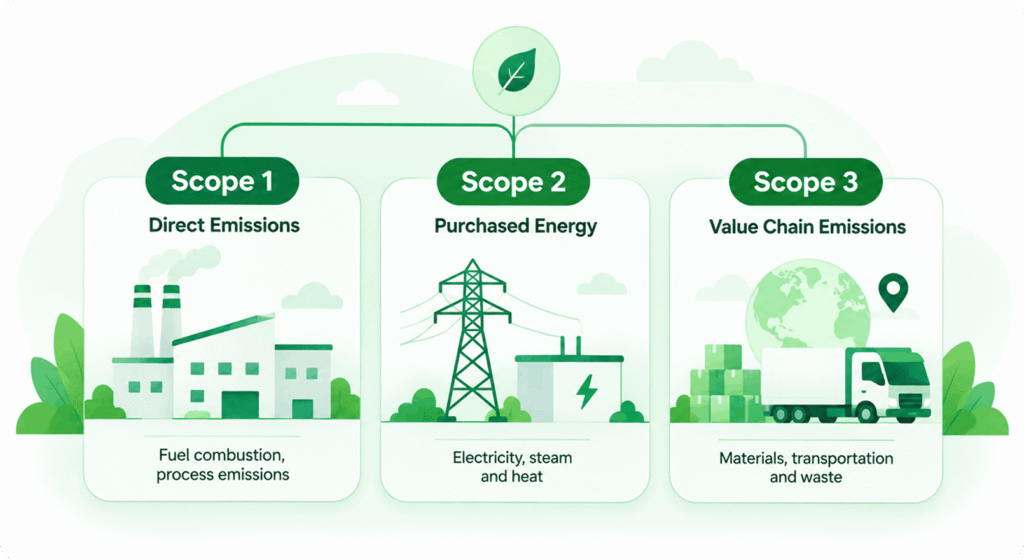
Before you can reduce the carbon footprint in industry, you need to map where emissions originate; this table categorizes key sources by scope, indicating where a product’s footprint begins inside and outside the plant.
Emission source
Fuel combustion on site
Scope
1
Examples
Boiler, furnace, kiln, company vehicles
Emission source
Process emissions
Scope
1
Examples
Cement production, steel production, chemical reactions
Emission source
Purchased electricity, steam and heat
Scope
2
Examples
Motors, compressors, HVAC, electric heaters
Emission source
Purchased materials and components
Scope
3
Examples
Steel, aluminium, polymers, packaging
Emission source
Inbound and outbound transportation
Scope
3
Examples
Road, rail, sea and air transport
Emission source
Waste
Scope
3
Examples
Landfill, incineration, production waste

Why is it so hard to reduce the carbon footprint in industry?
The benefits would be considerable. Estimates suggest that manufacturing and production account for one-fifth of global carbon emissions and 54% of the world’s total energy consumption.
According to the World Economic Forum, a combined approach to reduce carbon footprint in industry could cut emissions from Europe’s industrial clusters by up to 40% by 2030.
For most plants, the challenge is practical rather than a lack of willingness:
No baseline: The teams have knowledge about their own utility costs but not about the emission of one unit of product; therefore, they cannot prioritize any action.
Fragmented Data: The procurement, production, and logistics-related data is scattered in disparate systems that were never created for carbon accounting purposes.
Non-scalable spreadsheets: One product evolves into several spreadsheets covering materials, plants, and suppliers each designed a bit differently.
Un-defendable numbers: When auditors ask about how some number was calculated, “It’s a spreadsheet” would hardly be a proper response.
Shifting requirements: There is CBAM, there are questionnaires from clients, and there are national strategies.
Prioritizing is hard: It is difficult to understand where to focus – on energy consumption, materials or transportation without input-level numbers.
Every barrier to reducing the carbon footprint in industry traces back to the same gap: no trusted, product-level number.
At Octscope, we find that the manufacturers who struggle most are rarely short of data. Their records just sit in separate systems.
Why GCC manufacturers need to reduce the carbon footprint in industry?

Businesses across the Gulf region face growing pressure to reduce carbon footprint in industry and provide detailed product emissions data due to changing market expectations, international trade requirements, and government sustainability goals.
Customers and tenders want product-specific numbers.
It has become more common for procurement groups to ask for the footprint of the precise product being purchased, and it will be better off for a supplier able to provide that number rather than a generic estimate.
Export markets are putting a price on embedded emissions.
In 2026, the EU introduced the full implementation of its Carbon Border Adjustment Mechanism (CBAM), which applies to products such as cement, iron, steel, aluminium, fertilizers, electricity, and hydrogen. From 2028, the EU plans to extend these requirements to around 180 additional products made using steel and aluminium, mainly machinery and appliances.
This is particularly relevant to the UAE, which exported $2.7 billion worth of these regulated products to the EU in 2023, with aluminium making up a significant share.
Although Product Carbon Footprint (PCF) reporting is not the same as a CBAM declaration, having product-level emissions data will help businesses prepare for these requirements and respond more easily to future requests from international buyers.
National agendas raise expectations.
Saudi Arabia aims to reach net zero by 2060 and the UAE by 2050, creating strong policy incentives to reduce carbon footprint in industry even as Saudi Vision 2030’s National Industrial Strategy works to triple industrial output.
Octscope has developed its software in collaboration with GCC manufacturers and industrial users, assisting organizations in responding with documented inputs and assumptions. Octscope report does not equate to a CBAM statement.
9 Practical Steps to Reduce Carbon Footprint in Industry
01
Build a product-level carbon footprint baseline
1. Identifying primary contributors.
These could be, depending on your scope, raw materials and components, energy, transportation, direct process emissions, and also co-products and by-products (which may require allocation).
2. Collecting activity data consistently.
That is kilograms of materials, kWh electricity and fuels, and weight, distance and mode of transport. Each piece of data requires recording the source, facility and time period.
3. Calculate the emissions.
Multiply the amount of the activity by its emission factor:
Emissions (kg CO₂e) = Activity data × Emission factor
For instance, 1,200 kg of steel times 2 kg CO₂e per kg equals 2,400 kg CO₂e. The above is for illustration only; the factors depend on the material, manufacturing process, recycled component, geographical location and year. Refer to reliable sources, ensure the units match, perform the multiplication for all materials, fuels and other activities, then sum up the totals.
Related Topic: How To Calculate A Product Carbon Footprint
4. Set the boundary.
Indicate what product or SKU is considered, its declared unit (a single unit, a kilogram or batch), reporting period and life-cycle stages covered. Cradle-to-gate covers the process until the product leaves the plant, and cradle-to-grave includes distribution, use and disposal phases. Use an adequate method, such as ISO 14067.
Octscope ensures that every calculation begins with a template setting out the product, the plants, and the time frame for reporting, and thus determines the boundary first.
02
Find the hotspots at input level
Once your baseline is set, input-level analysis shows where efforts to reduce carbon footprint in industry will have the biggest impact by identifying which inputs deserve priority.
Only a few inputs constitute the majority of the footprint, like energy intensive inputs, inputs that have traveled the longest, or less efficient process inputs. The way to determine which are the significant ones is to determine which inputs produce the most emissions, external inputs that travel far, etc.
Internal and external inputs must be distinguished.
Internal inputs have your energy, material and process emissions embedded in them, and you manage these through efficiency. External inputs have the emissions embedded from the supplier’s production and delivery, which you manage through your supplier selection and logistics.
Look at transport.
Consider distance, mode, and weight for each load. Sample illustration: a load weighing 1,200 kilograms of steel is transported a distance of 340 kilometers using road transport.
1,200 kilograms = 1.2 tonnes
1.2 tonnes × 340 kilometers = 408 tonne kilometers
408 × 0.1 kg CO₂e per tonne kilometer = 40.8 kg CO₂e, or approximately 41 kg
Physical measurements vary depending on the vehicle, type of fuel, loads, location, and year. Consistency should be ensured when comparing plants and/or years.
At Octscope each input is declared as internal or external with transport mode and distance for external ones.
03
Reduce emissions from energy and manufacturing processes
Improvements in operations regarding energy consumption, processes, and yield reduce the amount of emissions that each one has.
To effectively reduce carbon footprint in industry, concentrate on high-emitting operations with the goal of minimizing energy and materials consumed per unit.
Increase energy efficiency.
Carry out maintenance and repair of machines, stop leaks in compressed air and steam supply, use variable speed drives when feasible, and recover wasted heat. In the case of a factory that consumes 500 kWh in producing 1,000 units, the factory now uses 400 kWh to produce the same number of units. This means 0.5 to 0.4 kWh per unit, 20% less than before. Emissions per unit decrease by 20%, assuming the source of power remains the same.
Choose cleaner energy.
Substitute fuels with higher carbon intensity, use renewable electricity, and electrify equipment when appropriate.
Optimize processes and cut waste.
Minimize downtime and setup activities. Waste of material means wastage of its emissions as well; therefore, optimize cutting patterns, minimize defects and recycle scrap when appropriate.
Measure the impact.
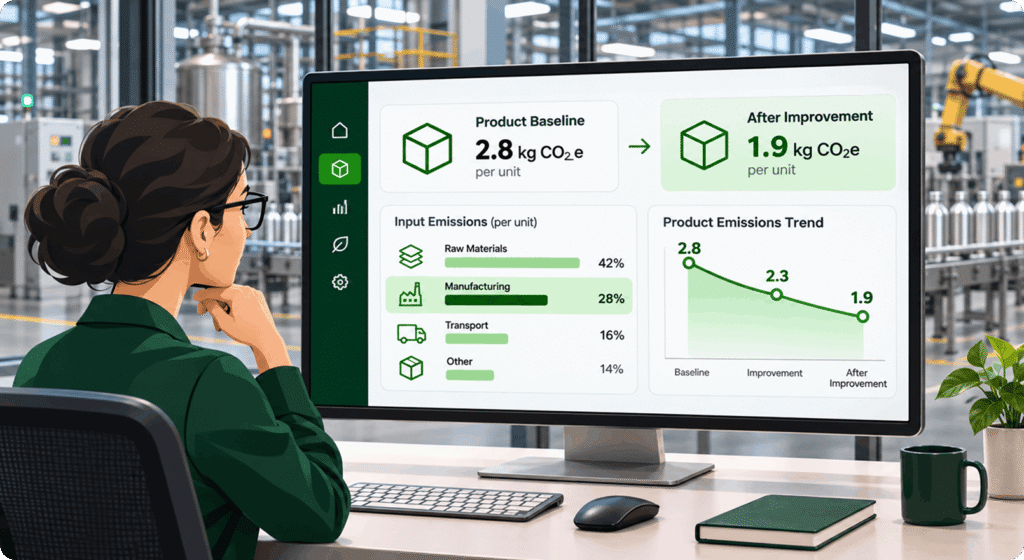
Compare the PCF outcomes on a period basis with the help of similar methodology, and measure emissions per unit and not total plant energy consumption.
In Octscope, the same template is used for each period in order to determine whether a difference exists in the outcome of the product.
04
Electrify and switch to cleaner power
Heating through the use of electricity and cleaner electricity can result in a reduction in emissions, as long as you capture the proper emission factors.
Switching from fossil-fuel heating to clean electricity is one of the fastest ways to reduce carbon footprint in industry.
As per the World Economic Forum, almost half of all industrial emissions are caused by light and medium industries, which have processes that could be electrified using commercial technology.
Identify what heating equipment can operate on electricity without hindering production, after that, consider alternative sources of energy.
The Gulf region manufacturers should use on-site solar power, renewable electricity contracts, and green tariffs where possible.
The effect will depend on the type of electricity being used, therefore, note down the emission factor of the electricity being used and the reference year for each calculation. At Octscope, all this information is provided alongside the product record.
05
Reduce the material footprint.
Embedded carbon depends on the design and sourcing decisions made for each individual material component.
Materials and purchased components may account for a significant portion of a footprint.
Important considerations include
Efficient materials use: optimized cutting and reduced parts. As Xometry explains, additive manufacturing sometimes uses less material than traditional manufacturing.
Use of low carbon inputs
recycled, plant-derived, or other materials, verified through data from suppliers.
Reduced weight
less material without loss of strength, potentially lowering transportation energy as well.
Design for recyclability and maintenance
durable products that spread manufacturing impact over their lifetime.
Consider the quantity and emission factor for each material because even small quantities of materials that have higher emission factors could overshadow larger quantities of materials with lower emission factors. At Octscope, quantities are indicated for each input to allow comparisons for different materials and sources.
06
Decarbonize your suppliers and transport.
Always try to request manufacturer specific emission data rather than industry averages. Keep a track of the mode, distance and volume of shipment of each externally sourced material individually. Same distance can lead to different levels of emissions due to the mode of transportation – road, rail, air or sea. Such details will help manufacturers to consolidate shipments, use an efficient mode of transportation and optimize routes.
At Octscope, transportation related details of each input are recorded to enable the team to discuss emissions with the supplier.
07
Plan for hard-to-abate processes
Some industries, such as steel, cement and chemicals, need very high temperatures or special chemical processes to make their products. Electricity cannot easily replace these requirements. The World Economic Forum and Accenture suggest four ways to reduce emissions from these industries.
Systems efficiency and circularity
Increase resource efficiency, recover energy from waste and recycle resources.
Electrification and renewable heat
Electrify heating where possible using renewable heat sources.
Hydrogen
produce or use low-carbon hydrogen as input, reductant or fuel where electrification is challenging.
Carbon capture, utilization and storage (CCUS)
Capture carbon dioxide and either use it or store it.
The above measures will need considerable investment. CCUS, for instance, will be easier to implement if industrial hubs are able to utilize shared transportation and storage facilities. Efficiency and electrification could yield quick returns, while hydrogen and CCUS could be included in your long-term strategy.
08
Prevent waste and close loops
Manufacturers can reduce emissions by creating less waste and using materials more efficiently. They can reuse products, recycle materials and avoid using more raw materials than necessary. Recovering energy from waste should be the last option. Remanufacturing and buyback programs can also help products last longer and reduce the need for new materials.
Sometimes, one manufacturing process produces several products. In this case, manufacturers need to decide how to divide the emissions between them. First, they should consider process subdivision (dividing the process into separate steps) or system expansion (considering additional products or functions together). If emissions still need to be divided, they can use the quantity or economic value of each product as a basis. The chosen method should be documented and applied consistently.
In Octscope, teams can use the reporting template to document how emissions are divided between products and co-products.
09
Verify, report and compare every cycle.
Reductions can only be counted where there is reliable data to prove them. Always use the same methodology using the same functional unit and specification each time period. Make note of any boundary changes, emission factors changes, allocation method changes or specification changes to allow all data to be traced and reviewed. Where required by the client or regulatory agency, use a methodology that meets the requirement before reporting the reduction.
At Octscope, the Product Carbon Emission Report (PDF) provides a link to each of the figures used based on the input, plants, and transportation legs. It acts as support for internal and external discussions, but not as verification.
7 Mistakes That Stall Efforts to Reduce Carbon Footprint in Industry
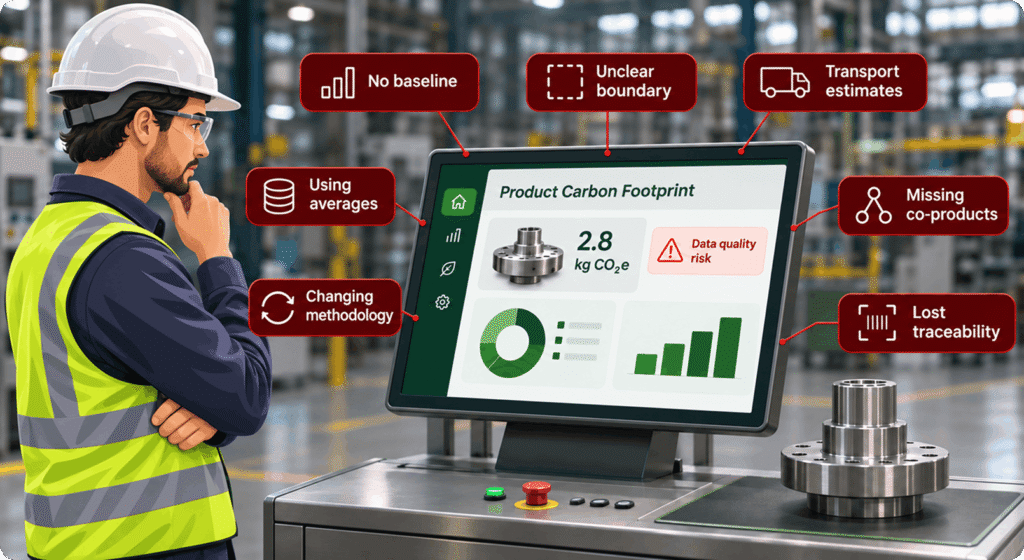
When teams work to reduce their carbon footprint, a handful of avoidable mistakes can undermine either the precision or the credibility of their product data. Here are the seven to watch for:
Measuring after cutting
Without a baseline, you can’t rank reduction options or prove your results.
No defined boundary
Without a clear boundary, you can neither compare results nor defend them.
Using estimates for bulk transportation
Estimates hide the effect of transport mode and distance.
Using averages when specific data is available
Averages are easier to apply but much harder to defend.
Switching methodologies over time
What you observe may reflect a change in method, not a change in the product.
Omitting co-products
Shared emissions must be allocated properly, since they directly affect the primary product’s footprint.
Losing traceability
If you can’t show which inputs, plants, factors, and transport legs produced the number, you can’t defend it under scrutiny.
How Octscope Helps Reduce Carbon Footprint in Industry
Octscope is product carbon accounting software built to help manufacturers reduce carbon footprint in industry by establishing the trusted, product-level baseline that every step above relies on.
The process includes creating a template that will define the product, plants and reporting period, importing your data, declaring inputs whether internal or external, adding transport for each input, and then generating the report. Octscope measures your product and co-product emissions and outputs a PDF of the Product Carbon Emission Report.
Since the template is reusable, you can apply the same template to different reporting periods, plants, and products. Access controls by features allow plant, sustainability, and leadership teams to have access to data that pertains to their areas of work. Octscope collects data from your databases without making any copies or training AI models with the collected data.
Conclusion
To reduce carbon footprint in industry with confidence, manufacturers need unified data—and our platform brings production, purchasing, and transportation records together to generate traceable Product Carbon Emission Reports.
Ready to learn where your product emissions really stand?
Try Octscope for free or schedule a demo today.
Frequently Asked Questions
Where do industrial carbon emissions come from?
They come from on-site fuel combustion (boilers, furnaces, kilns), process emissions (such as cement and steelmaking), purchased electricity, purchased materials, transport and waste. The largest share often sits in materials and energy, which is why measuring each source separately is the first step to reduce the carbon footprint in industry.
Why is it so hard to reduce the carbon footprint in industry?
The obstacle is usually operational, not a lack of ambition. Common barriers include no baseline, data scattered across systems, spreadsheets that don’t scale, figures that can’t be defended, changing requirements such as CBAM, and unclear priorities between energy, materials and freight.
What are the most effective ways to reduce carbon footprint in industry and manufacturing?
Start with energy efficiency (leak repair, variable-speed drives, waste heat recovery), then move to cleaner energy and electrification, lower-carbon materials, supplier and transport improvements, and waste prevention. Hard-to-abate processes may need hydrogen or CCUS over the longer term.
What mistakes should I avoid when reducing industrial emissions?
The most common are cutting before measuring, having no stated boundary, using bulk transport estimates, relying on generic averages, mixing methods between years, ignoring co-products, and losing the audit trail behind the number.
How does Octscope calculate product carbon emissions?
You create a template defining the product, plants and reporting period, bring in your data, declare inputs as internal or external, add transport per input, then generate the report. Octscope calculates product and co-product emissions from that structured data.
How can I get my data into Octscope?
You can connect a structured database, upload a JSON, Excel or CSV file and map the fields, or enter data manually. Octscope reads from your databases without copying them or using them to train AI models.
Is Octscope suitable for GCC manufacturers?
Octscope was built alongside manufacturers and industrial clients in the GCC looking to reduce carbon footprint in industry and respond to tenders and buyers asking for product-specific figures. It helps teams respond with documented inputs and assumptions, supporting tender, customer and export-market requests.
How do I get started with Octscope?
You can start for free or book a demo. Begin with one product, define its boundary and reporting period, import your data, and generate your first Product Carbon Emission Report.