
How To Calculate A Product Carbon Footprint
In this article
- What Is The Product Carbon Footprint Formula?
- What Do You Need To Decide Before Calculating A Product Carbon Footprint?
- How To Calculate A Product Carbon Footprint?
- What Are The Common Mistakes To Avoid?
- Why Do Spreadsheets Stop Working?
- How Octscope Calculates A Product Carbon Footprint?
- Conclusion
You can’t reduce what you can’t trace.
Start with the product data you already have.
Understanding Product Carbon Footprint Calculation for Manufacturers.
Every manufacturer is now asked some version of the same question: what does this specific product cost in emissions? It arrives in an RFQ, a customer questionnaire or an audit request, and the answer has to be a number you can explain, not an estimate pulled from a generic average.
At Octscope, we focus on helping manufacturers turn production, purchasing and transport data into consistent, traceable product carbon footprint calculations. Our approach starts with the information businesses already have and organises it into a repeatable calculation process, so teams can understand where their numbers come from and explain the results to customers and other stakeholders.
This guide explains how to calculate your carbon footprint of a product, step by step, using production, purchasing and transport data. It is written for manufacturers. If you want to learn how to calculate your company’s carbon footprint, remember that a company-wide assessment covers emissions across organisational activities, whereas a product carbon footprint focuses on one product, made at your plants, over a defined period. Both assessments require clear boundaries, appropriate data and consistent calculation methods.
What Is The Product Carbon Footprint Formula?
The Formula Behind Product Carbon Footprint Calculation.
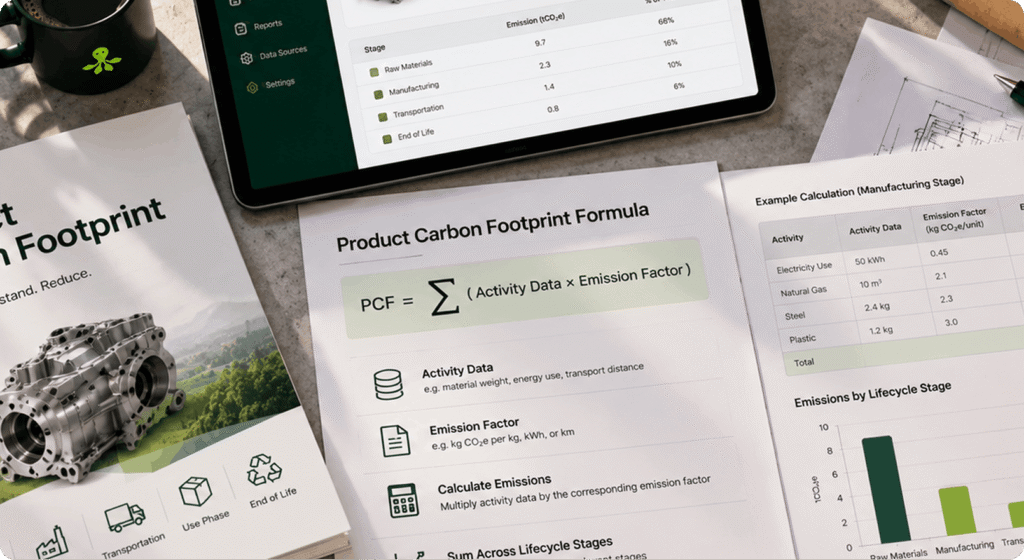
A product carbon footprint (PCF) refers to the total emissions attributed to one product, expressed in carbon dioxide equivalent (CO₂e). The core calculation is simple:
Emissions (kg CO₂e) = Activity data × Emission factor
Activity data is what happened: kilograms of material, kilowatt-hours of electricity, tonne-kilometres of freight. The emission factor converts that activity into CO₂e. You do this for every input that falls inside your boundary, then add the results together.
At Octscope, we structure product data around the inputs, production information and transport details needed to calculate a footprint. This helps manufacturers move beyond isolated spreadsheet calculations towards a consistent method that can be reused across reporting periods.
The hard part is not the multiplication. It is deciding what is inside the boundary, collecting clean data for every input, and doing it the same way every time.
What Do You Need To Decide Before Calculating A Product Carbon Footprint?
Key Decisions Before Starting Your Product Carbon Footprint Calculation.
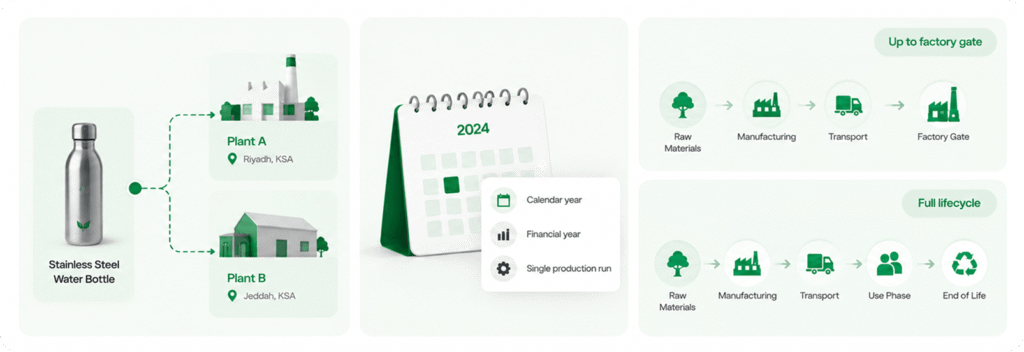
Before you learn how to calculate your carbon footprint, settle the three decisions below. Skip these and two people can calculate the same product and get different answers.
01
The product and its plants
Which product, made at which plant? A product made at two sites usually has two different footprints, so be explicit. Octscope’s product templates allow manufacturers to define the product and relevant plant information before populating the data needed for each calculation.
02
The reporting period
A calendar year, a financial year or a single production run. Using the same period every cycle is what makes year-on-year comparison meaningful. With help of us, manufacturers can reuse the same product template for subsequent reporting periods, helping maintain a consistent calculation structure as new data becomes available.
03
The boundary
This is the line between what you count and what you leave out. Common boundaries run from raw material extraction to the factory gate (cradle-to-gate) or all the way through use and disposal (cradle-to-grave). Whatever you choose, write it down, because the first thing a customer or auditor will ask is what the number includes.
Our approach at Octscope makes input classification an explicit part of the product template. Manufacturers can distinguish internally produced inputs from externally sourced ones and record the information used in the calculation. This makes the chosen boundary easier to communicate and helps teams identify when a customer requires a broader assessment.
How To Calculate A Product Carbon Footprint?
A Step-by-Step Guide on how to calculate your carbon footprint.

01
Define the product, plants and reporting period
Start by naming exactly what you are calculating: the product, the plant that makes it, and the reporting period. Also choose the unit the result is expressed in, for example per unit, per kilogram or per batch. This is your functional unit, and it keeps results comparable across products and years.
Treat this as a template you will reuse, not a one-off setup. The product’s structure rarely changes between cycles, so you should not have to rebuild it every time.
At Octscope, we use reusable product templates to organise the information needed for each footprint calculation. Once the product structure, relevant plants and reporting details have been established, manufacturers can reuse that structure for later reporting cycles rather than rebuilding the calculation from scratch.
02
List every input that goes into the product
Break the product down into everything that goes into making it: raw materials, components, purchased parts, packaging, and any intermediate products made in-house. Your bill of materials is the natural starting point.
For each input, record the quantity used during the reporting period.
Our templates are designed to capture product inputs and their associated information in a consistent structure. Manufacturers can populate the required fields by uploading supported files, connecting a structured database and mapping the relevant fields, or entering the information manually. This gives teams a practical way to organise existing product data without requiring every source to follow the same format.
03
Classify each input as internal or external
This is the step most calculations get wrong, and it determines how each input is counted.
Internally produced inputs
If you made the input yourself (for example, a stamped part produced at your own plant), the emissions generated while producing it count toward the product.
Externally sourced inputs
If you bought the input from a supplier or another company, you count the emissions from transporting it to you. The emissions from producing it belong to whoever made it.
This distinction is central to how Octscope structures product calculations. Our templates record whether inputs are internally produced or externally sourced, so the calculation can follow the selected input treatment instead of relying on assumptions hidden inside a spreadsheet.
Stating this rule plainly, and applying it consistently, is what makes a footprint explainable. It also means you should be clear with customers about what your number covers. If a customer expects a wider boundary that includes supplier production emissions, agree that up front rather than discovering the mismatch at audit.
Important: The internal-versus-external treatment described here is the rule used in this illustrative example, not a universal rule for every PCF methodology. Supplier production emissions may need to be included for a cradle-to-gate assessment. Confirm the applicable boundary and methodology before reporting a footprint to customers.
04
Collect the activity data
Now gather the data behind each input. For a typical manufactured product this means:
For internal inputs
Electricity (kWh), fuel or gas use, and any process emissions at the plant, attributed to the product.
For external inputs
The supplier or source location, the transport mode (road, rail, sea, air) and the distance travelled.
For everything
The weight or quantity of each input, so transport can be expressed in tonne-kilometres.
Most of this already exists in your production, purchasing and logistics systems. Collecting it cleanly is the practical heart of how to calculate your carbon footprint. The work is getting it into one consistent structure instead of re-keying it into a new spreadsheet each cycle. Where data lives in a database, a file, or only in someone’s head, use whichever route gets you a complete record, and note the source of each figure.
Octscope supports three ways to bring product information into the calculation: connect a structured database and map its fields, upload supported files such as Excel or CSV and map the data, or enter information manually. Our approach is to work with the data manufacturers already have, while keeping the relevant product inputs, origins and transport details organised within a reusable template.
For reliable results, we recommend retaining the source of each figure, checking units and quantities before calculation, and flagging missing information rather than silently replacing it with an assumption. These checks help make the resulting calculation trail easier to review.
05
Apply emission factors
Convert each piece of activity data into kg CO₂e using an emission factor appropriate to it:
- Electricity: kg CO₂e per kWh, specific to your grid and year
- Fuel and gas: kg CO₂e per kWh or per unit of fuel
- Freight: kg CO₂e per tonne-kilometre, specific to the transport mode
Use factors from a recognised source, match them to your country and year, and record which ones you used. Your own measured or supplier-specific data is better than a generic average wherever you have it.
We emphasise consistent, traceable calculations built around structured product data. However, the quality of a product carbon footprint also depends on the emission factors selected and the methodology applied. Manufacturers should retain the factor values, sources, geographical relevance, reference years and assumptions used, so reviewers can understand how activity data was converted into emissions.
Where a recognised framework or customer-specific methodology applies, verify that the selected factors and calculation approach meet its requirements before reporting the result.
06
Handle co-products
Many processes make more than one output: a main product plus a co-product or by-product. The emissions of the shared process have to be divided across all of them in a defined, documented way. Allocating by hand in a spreadsheet, or ignoring co-products altogether, is one of the most common reasons footprints cannot be defended. Choose one allocation method, apply it every time, and state it in your report.
Octscope includes co-product calculations within its product reporting workflow, reducing the need to manage these outputs separately in spreadsheets. For manufacturers, this helps keep co-products within the same calculation structure as the main product.
The allocation method still matters. Depending on the applicable methodology and process, emissions may need to be allocated using mass, economic value, energy content or another justified basis. Document the method and the data supporting it, and confirm that the approach is appropriate for the product and reporting requirements.
07
Add it up, document it and report
Sum the emissions from every input inside your boundary. That total, divided by the quantity produced, gives the footprint per functional unit.
Then document what sits behind the number: the plants in scope, the reporting period, each input and its source, the transport mode and distance, the emission factors used, and how co-products were treated. A figure that arrives with this trail attached is far easier to defend than one that arrives alone.
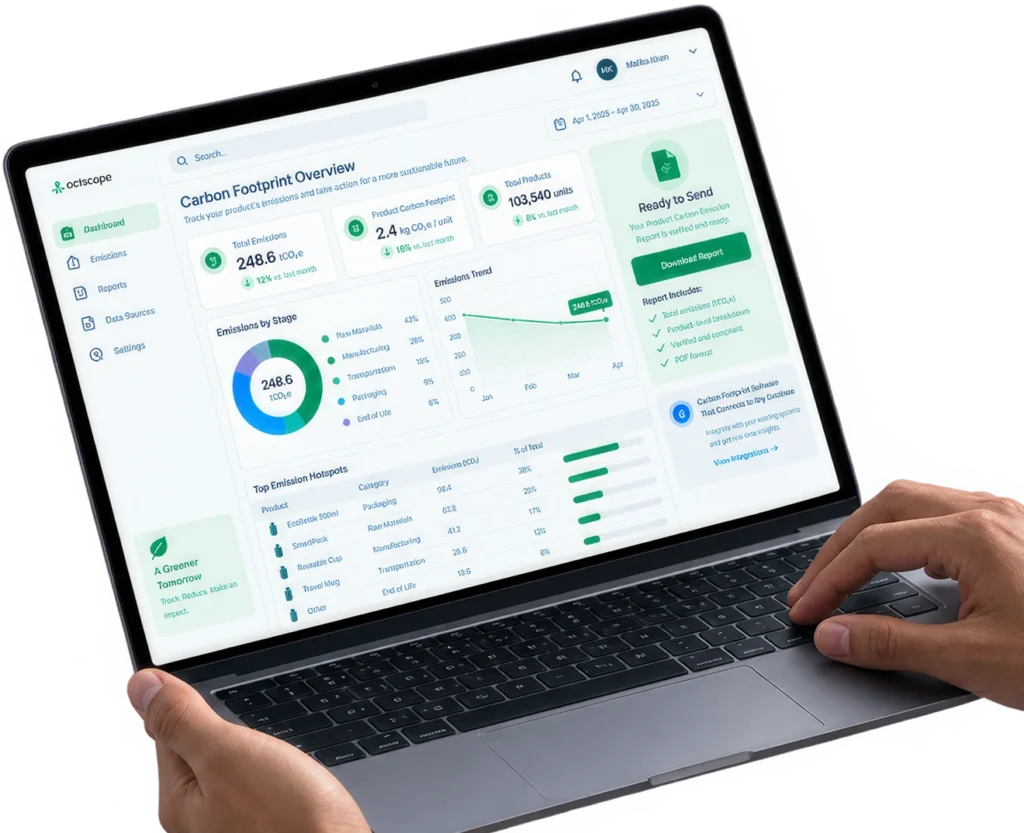
Octscope brings the product information and calculation output together in a Product Carbon Emission Report generated as a PDF. The report presents relevant details about the product, inputs, sources, transport, plants and reporting period, giving teams a structured record to support internal reviews and customer discussions.
Our focus is on making the calculation repeatable and traceable. Before sharing a report externally, manufacturers should also verify that the selected boundary, emission factors, allocation method and supporting evidence satisfy the requirements of the intended customer, reporting framework or independent reviewer. Once you have a number you trust, learn more about reducing the carbon footprint in manufacturing by focusing on the biggest contributors.
Calculate Your Product's Carbon Footprint
Get a ready-to-send, verified Product Carbon Emission Report.
What Are The Common Mistakes To Avoid?
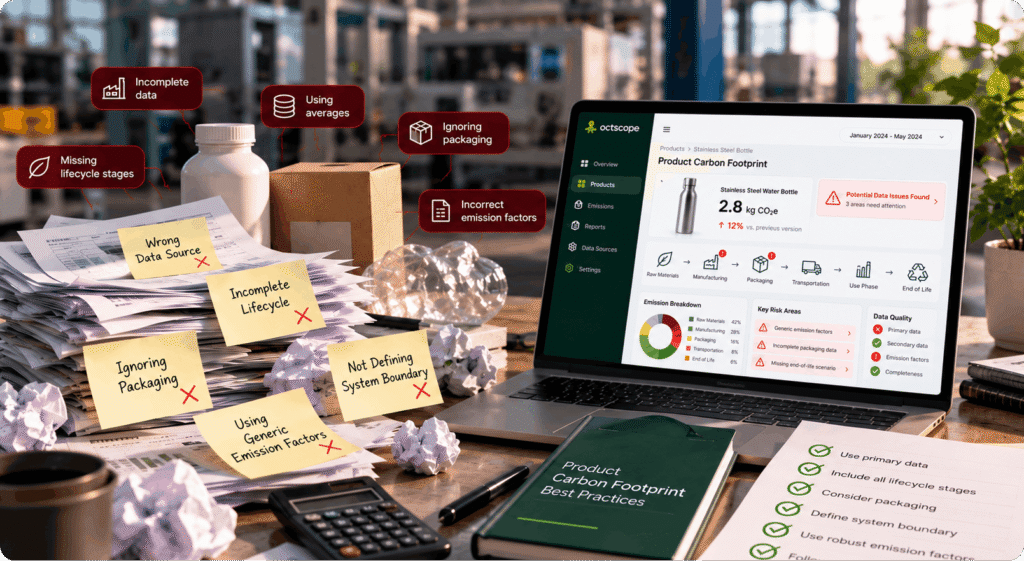
Common Product Carbon Footprint Calculation Errors.
Even when you know how to calculate your carbon footprint, a well-organised calculation can produce misleading results if the underlying assumptions or data are wrong. At Octscope, our approach is to organise product inputs, source details and transport information in a consistent structure, helping manufacturers maintain a clearer record of the information used.
No stated boundary
A number without a boundary cannot be compared or defended.
Estimating transport in bulk
Capturing mode and distance per input is more accurate and easier to explain than one lump figure for all freight.
Miscounting external production emissions
Define the applicable boundary and input treatment, then apply them consistently.
Mixing methods between years
If this year’s calculation is built differently from last year’s, the change you see may reflect the method rather than the product.
Ignoring co-products
Failing to allocate shared process emissions appropriately can distort the main product’s footprint.
Losing the trail
If you cannot show which inputs, plants, factors and transport legs produced the number, you cannot adequately answer a customer or auditor challenge.
A reusable calculation structure can help reduce these problems, but it does not replace sound data validation, appropriate emission factors or a methodology suited to the reporting requirement.
Why Do Spreadsheets Stop Working?
Moving Beyond Spreadsheets for Product Carbon Footprint Calculations.
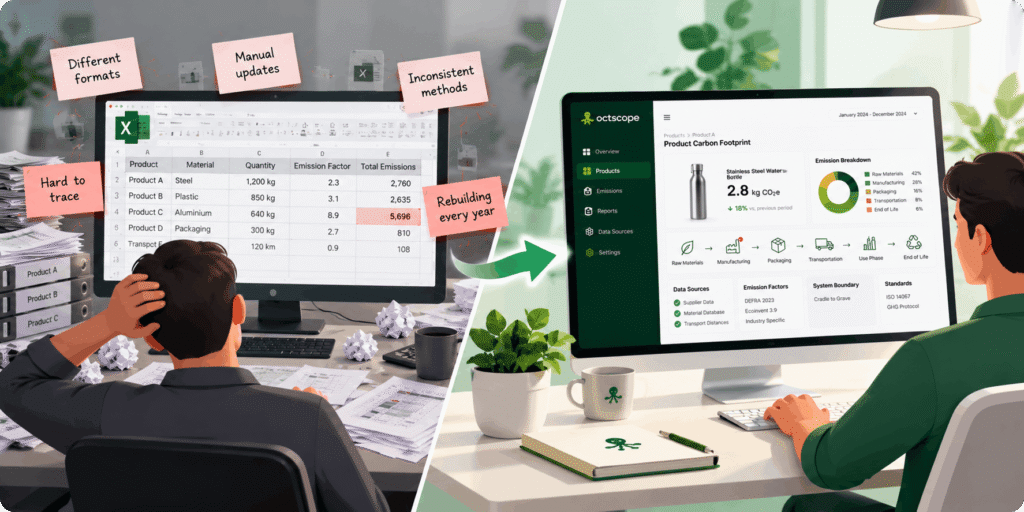
A spreadsheet is fine for the first product. It struggles when one product becomes dozens of calculations across different materials, plants and suppliers, when each person builds it slightly differently, and when you have to repeat the exercise every year. The real cost is not calculation time. It is rebuilding the structure and re-keying the data each cycle, and then being unable to show how a number was reached.
At Octscope, we designed the workflow around the recurring nature of product carbon footprint calculations. Instead of starting from an empty spreadsheet for every product or reporting period, manufacturers can reuse templates, bring in data from existing sources, classify inputs and record transport information within a consistent structure.
This is particularly useful when teams need to calculate footprints for multiple products or repeat the same process annually. The underlying product structure can be retained while the relevant period-specific information is updated, helping reduce repetitive setup and making calculation records easier to review.
Spreadsheets can still be useful for initial data preparation and smaller calculations. Learning how to calculate your carbon footprint in a spreadsheet is a sensible start for a single product. The challenge is maintaining consistent methods, traceable inputs and repeatable reporting as the number of products and data sources grows.
How Octscope Calculates A Product Carbon Footprint?
Octscope’s Product Carbon Footprint Calculation Process.
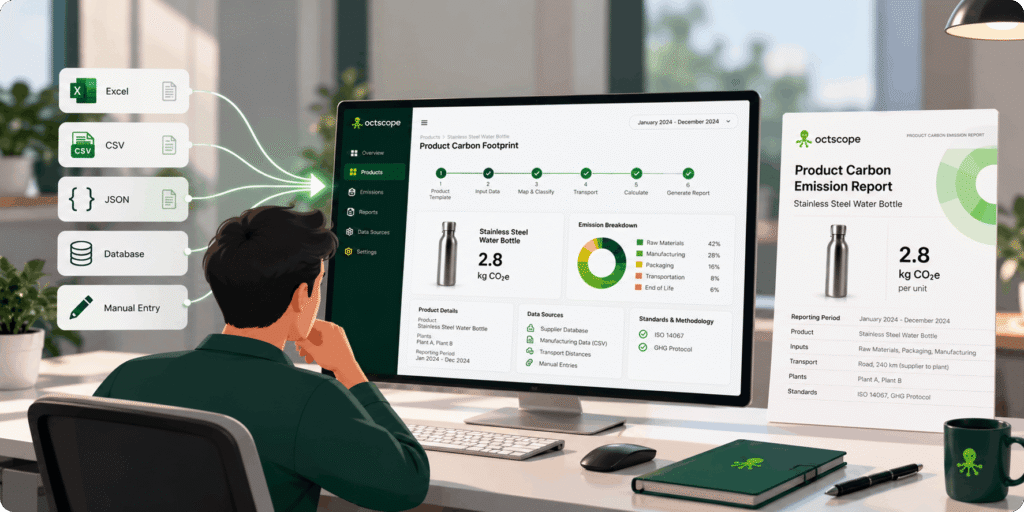
Octscope is built around the steps above. You set up a product template once, covering the product, plants and reporting period. You then populate it from the data you already have: connect a structured database, upload a supported file such as JSON, Excel or CSV and map the fields, or enter data manually.
Each input is declared as internal or external, and for externally sourced inputs you record the transport mode and distance. Octscope calculates the emissions for the product and its co-products and produces a Product Carbon Emission Report as a PDF, showing the product, inputs, sources, transport, plants and reporting period. . See how Octscope works in full.
Our approach centres on three things manufacturers need from a PCF workflow: consistent calculation structures, traceable product data and reusable reporting processes. These help teams organise the information behind their product footprints and explain how the results were produced.
Because the same template structure can be reused each cycle, manufacturers have a more consistent starting point for year-on-year comparisons. To make those comparisons meaningful, they must still review changes to the reporting boundary, emission factors, data quality, allocation rules and methodology.
Octscope’s workflow is designed to support structured, repeatable product carbon footprint calculations. Where a customer or regulator requires conformance with a specific standard, independent verification or a broader lifecycle assessment, manufacturers should confirm that the complete calculation and supporting evidence meet those requirements.
Ready to move beyond spreadsheet-based product carbon calculations? Explore how Octscope helps manufacturers structure their product data and generate traceable Product Carbon Emission Reports.
Conclusion
Knowing how to calculate your carbon footprint requires accurate activity data, appropriate emission factors, a clearly defined boundary and consistent methodology. These elements help manufacturers produce reliable, traceable results and respond to customer reporting requirements.
At Octscope, we help manufacturers organise production, purchasing and transport data through reusable templates, structured calculations and PDF-based Product Carbon Emission Reports. Explore Octscope to simplify your product carbon footprint workflow and make reporting more consistent and traceable. Contact us to get started.
Calculate Your Product's Carbon Footprint
Start building a more traceable product carbon footprint with Octscope and turn scattered product data into actionable emissions insights.
Frequently Asked Questions
How do you calculate the carbon footprint of a product?
Here is how to calculate your carbon footprint for a product: start by defining the product, manufacturing plant, reporting period and assessment boundary. List the materials and other inputs, collect relevant activity data, apply appropriate emission factors, account for co-products where necessary, and add the emissions within the boundary. Divide the total by the chosen functional unit to calculate the footprint per unit of product.
What is the formula for calculating a product carbon footprint?
The basic formula is:
Emissions (kg CO₂e) = Activity data × Emission factor
Apply this formula to each relevant activity, such as electricity consumption, fuel use or freight transport. Add the resulting emissions to calculate the total within the defined boundary.
What data is needed to calculate a product carbon footprint?
Manufacturers typically need a bill of materials, input quantities, production energy and fuel data, supplier or source information, transport modes and distances, and appropriate emission factors. The exact data requirements depend on the product, assessment boundary and applicable methodology.
What are the common mistakes in product carbon footprint calculations?
Common mistakes include failing to define the assessment boundary, estimating transport emissions using broad averages, using inconsistent methods between reporting periods, overlooking co-products and failing to retain supporting records. Manufacturers can reduce these risks by documenting assumptions, checking data quality, using appropriate emission factors and maintaining a traceable calculation record.
How does Octscope help calculate product carbon footprints?
Octscope provides a structured workflow for organising product information and calculating product carbon footprints. Manufacturers can reuse product templates, connect a structured database and map its fields, upload supported files such as Excel or CSV, or enter data manually. The workflow also supports input classification, co-product calculations and PDF-based Product Carbon Emission Reports.
Can Octscope help calculate carbon footprints for multiple products and reporting periods?
Octscope’s reusable product templates provide a consistent starting structure for calculations across products and reporting periods. Manufacturers can retain the product structure and update relevant period-specific information. Meaningful comparisons still require consistent boundaries, appropriate emission factors, reliable data and documented calculation methods.