Hero Image mobile

Turn Connected Production Data Into Audit Ready Product Carbon Reports

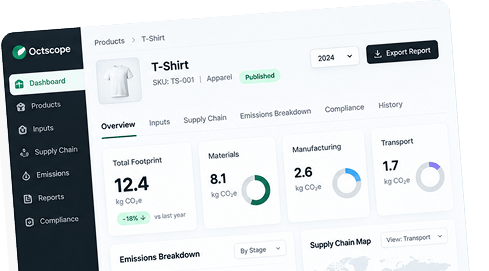
Calculate product carbon footprints from the production, purchasing, and transport data you already have with a consistent, traceable calculation method.

DISO 14040 / 14044
PACT V3 (Pathfinder)
Third-party auditable trails
EU PEF methodology
Traceable Data
Data Encryption

The Problem With Product Carbon Footprint Calculations

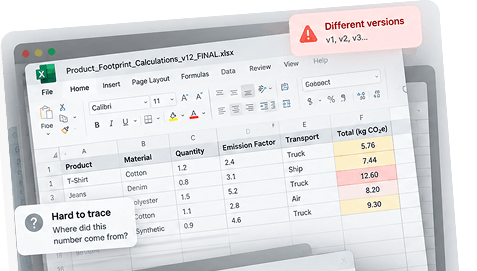
Calculating product-level emissions still means spreadsheets

Every manufacturer now gets asked the same question, from a customer, a tender, or an auditor: what does this specific product cost in emissions? Most teams still answer it by hand.

The data is scattered across systems.

Purchase records, production logs, transport documents. None of it was built to feed a carbon.

One product becomes dozens of calculations.

Different materials, different plants, different suppliers spreadsheets don’t scale to that combination.

Nothing is comparable.

Built ad hoc each time, this year’s number and last year’s number were never calculated the same.

The calculation trail gets lost.

When a customer or auditor asks how a number was calculated, “a spreadsheet” isn’t an answer.

How Octscope Calculates Your Product Carbon Footprint
From product data to a finished report, in five steps

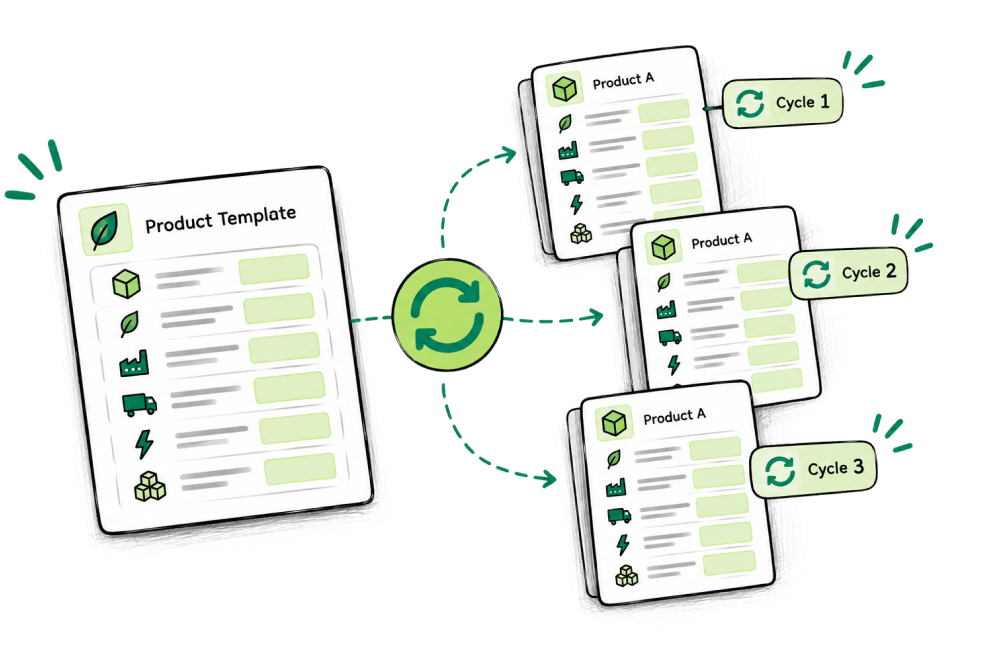
Create a template

Define the plants, product, reporting period and the fields needed to capture its inputs and source information.

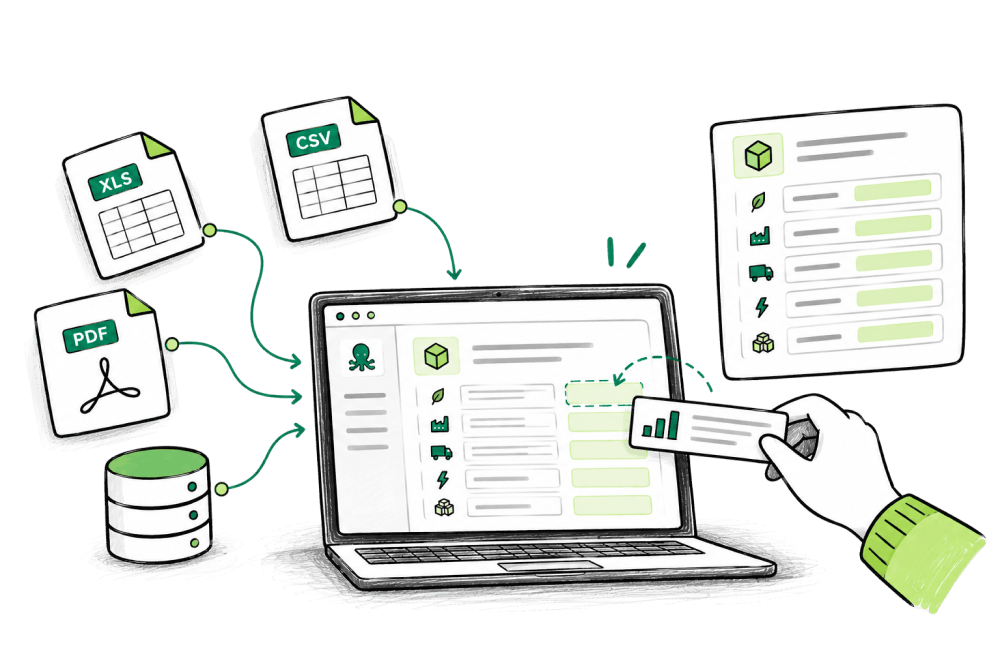
Bring in the data

Populate the template using the data you already have. Upload a spreadsheet or supported file and map its fields, connect a structured database and map the relevant data, or enter the information manually.

Declare the inputs

Record what went into the product and whether each came from inside or outside your organisation.

Add transport per input

Record the transport mode and distance for inputs sourced externally.

Generate the report

Octscope calculates the product and co-product emissions for the reporting period and generates a Product Carbon Emission Report as a PDF.

The Gap Between a Guess and a Number You Can Defend

Without Octscope

Without Octscope

Generic, hard-to-defend numbers.

Ad-hoc spreadsheet calculations leave no consistent trail, making customer or auditor challenges hard to answer.

Claims that are difficult to substantiate.

When the underlying inputs aren’t clearly documented, explaining the calculation becomes harder.

One calculation method per person who built it.

Results depend on how the spreadsheet was structured.

Transport emissions estimated in bulk.

Not tracked by mode and distance per input.

Co-products allocated by hand.

One of the hardest parts of a footprint left to guesswork.

One-off calculations that don't scale.

No reusable foundation, every new product or year starts again from zero.

With Octscope

With Octscope

Product-specific, traceable numbers.

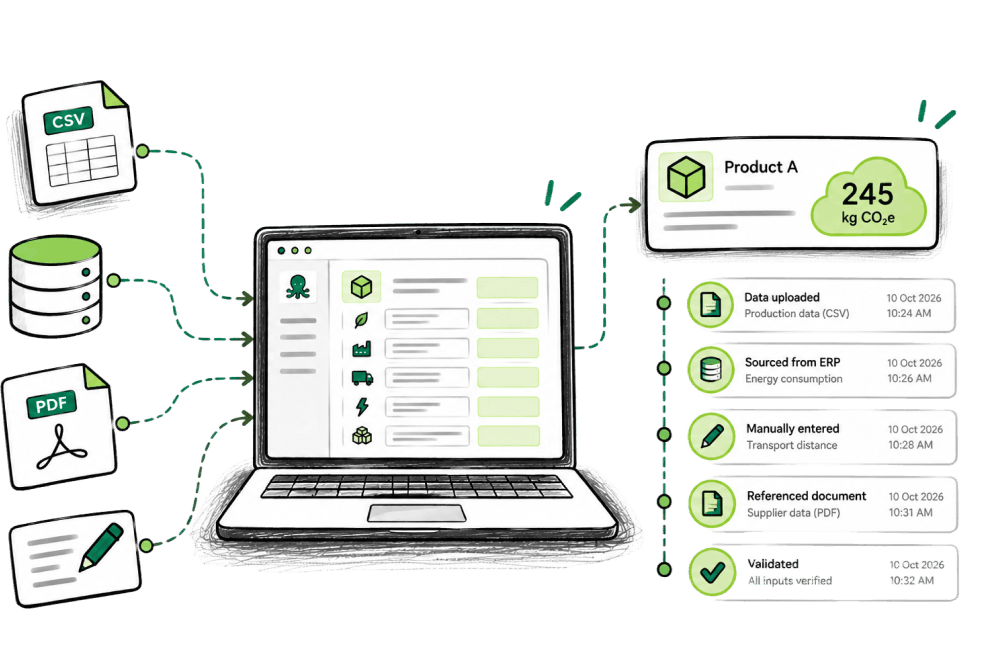
Every input, its origin, and its transport are recorded, so the number can be explained and defended, not just quoted.

Numbers you can explain

A footprint built from your own source data gives your team the inputs and calculation trail behind the result.

One consistent template, reused every time.

The same method runs every cycle, for every product.

Transport tracked per input.

Mode and distance are captured for externally sourced inputs.

Co-products calculated automatically.

Built into the template output.

A foundation that scales with you.

New products, new plants, new reporting years all build on the same structure.

What's inside Our PCF Software

From product data to a finished report, in five steps

Bring your existing data into the right fields

Bring your existing data into the right fields

Every product template defines the information Octscope needs for the calculation. Instead of forcing you into one data source, the platform lets you populate those fields using the data you already have.

Build a template once, reuse it every cycle

Build a template once, reuse it every cycle

Set up a product’s components, inputs, origins, production information and transport structure once. Reuse that structure when generating the footprint for another reporting period.

Every input traced, correctly

Every input traced, correctly

For internally produced inputs, production emissions are counted. For external inputs, transport emissions are calculated based on the mode and distance recorded in the template.

Co-products handled within the calculation

Co-products handled within the calculation

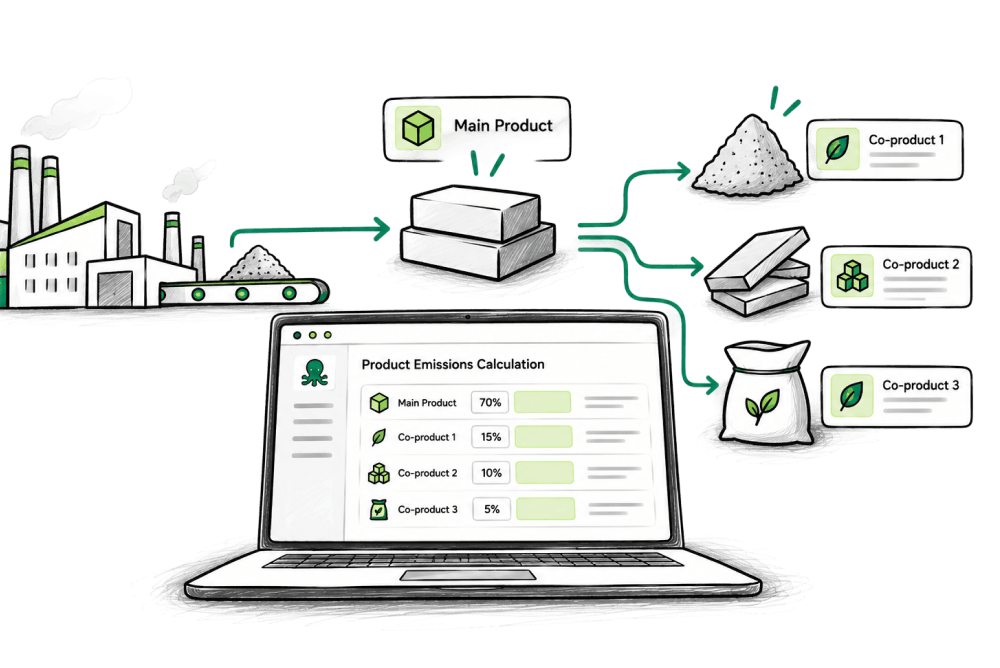
Octscope calculates emissions across the products and co-products, reducing the need to handle those outputs separately in spreadsheets.

Built For Manufacturers, Not Just One Sector

Octscope works across manufacturing industrial components, chemicals and materials, food and beverage, packaging, and metals and heavy industry. If your product has a bill of materials and a supply chain, it can be footprinted here.

Industrial and discrete manufacturing

Chemicals, plastics and building materials

Food, beverage and FMCG

Packaging Industry

Metals and heavy industry

Textiles and apparel

Regulations Change. Your Product Data Shouldn't Have To

Meet the standards your stakeholders already require

New reporting requirements arrive faster than most teams can rebuild their calculation process. Octscope gives you an input-level foundation that can be reused as requirements change, so you don’t have to rebuild your product data from scratch each time. Every number traces back to its source, the input, the plant, and the transport leg, keeping your underlying product data structured and usable as new reporting frameworks or market requirements emerge.

ISO 14040 / 14044

PACT V3 (Pathfinder)

EU PEF methodology

Third-party auditable trails

ISO 14040 / 14044

PACT V3 (Pathfinder)

EU PEF methodology

Third-party auditable trails

Calculate Your Product's Carbon Footprint

Talk to our experts and see the Product Carbon Footprint Software in action.

CTA-image

Frequently Asked Questions

What is product carbon footprint software?

Product carbon footprint software calculates the greenhouse gas emissions generated by a specific product across its lifecycle as distinct from corporate carbon accounting, which measures a whole organisation. Octscope calculates this at product level, using your own production and purchasing data.

A spreadsheet has to be rebuilt for every product, plant, and reporting year, and results aren’t reliably comparable. Octscope uses a reusable template and connected data, so every calculation follows the same method and can be compared year on year.

Yes. A template’s output includes emissions across every product and co-product it generates.

A Product Carbon Emission Report for the reporting period, exported as a PDF, covering the product, its inputs, transport, and any co-products.

You can start by entering the required data manually, uploading existing data and mapping it to the template fields, or connecting a structured database and mapping the relevant data. The method depends on where your data already exists. 

Octscope is built so template setup and reporting don’t require specialist knowledge The platform handles the calculation logic once your data is in.

Because every input is tracked at the source origin, transport, plant your underlying data doesn’t need to be rebuilt when a new reporting requirement appears. New frameworks can reuse the same foundation instead of starting over. 

Three things: speed no rebuilding the calculation from scratch each cycle; scale one template works across products, plants, and years instead of one spreadsheet per calculation; control you own the data, and it stays in your systems rather than being handed to a locked, generic model. 

Octscope is built so template setup and reporting don’t require specialist knowledge. The platform handles the calculation logic once your data is in.

Yes. Octscope can work with data from structured databases and supported file uploads, and you can also enter data manually. The relevant data is mapped to the fields defined in your product template.

Scroll to Top