
The Importance of The Carbon Footprint
In this article
- What A Product Carbon Footprint Actually Is?
- The Importance Of The Carbon Footprint: Three Pressures On GCC Manufacturers
- What Vision 2030 Means For Manufacturers?
- Where GCC Manufacturers Get Stuck?
- What A Defensible Product Carbon Footprint Needs?
- How Does Octscope Help Manufacturers Calculate Product Carbon Footprints?
- Conclusion
You can’t reduce what you can’t trace.
Start with the product data you already have.
For years, a carbon footprint was something a sustainability report mentioned once a year. In the Gulf, that is changing quickly. A buyer asks for the footprint of a specific product before awarding a tender. An export market starts charging for the emissions embedded in goods crossing its border. A national strategy sets industrial targets that factories are expected to help meet.
The question manufacturers now hear is no longer “are you cutting emissions?” It is “what is the footprint of this product, and how do you know?”
At Octscope, we focus on helping manufacturers organise product-level data and use it to calculate and report product carbon footprints. Our approach recognises that a useful footprint is more than a single number. Manufacturers need to understand which inputs contributed to the result, how transport was accounted for, and how the calculation was produced.
In this blog, we explain the importance of the carbon footprint for GCC manufacturers, how Vision 2030 and regional policies are raising the stakes, and what businesses need to produce a product footprint they can explain and substantiate.
What A Product Carbon Footprint Actually Is?
Understanding What A Product Carbon Footprint Represents.

Understanding the importance of the carbon footprint starts with knowing what a product footprint represents. A product carbon footprint (PCF) measures the emissions associated with a specific product within a defined system boundary, expressed in CO₂e. It answers a practical question: what emissions are associated with this item, considering the materials used to make it, where those materials came from, and how they were transported?
When a customer, procurement team or auditor asks about a particular product, they need information specific to that item, not a general figure.
At Octscope, we approach product carbon footprint calculations by organising the inputs that make up a product and the relevant transport information associated with those inputs. This helps manufacturers move from scattered operational records towards a more structured calculation process.
The calculation must also reflect the product’s defined boundary, appropriate emissions factors and relevant life-cycle stages. These details matter because two footprint figures cannot be meaningfully compared unless their underlying methods and boundaries are sufficiently consistent.
The Importance Of The Carbon Footprint: Three Pressures On GCC Manufacturers
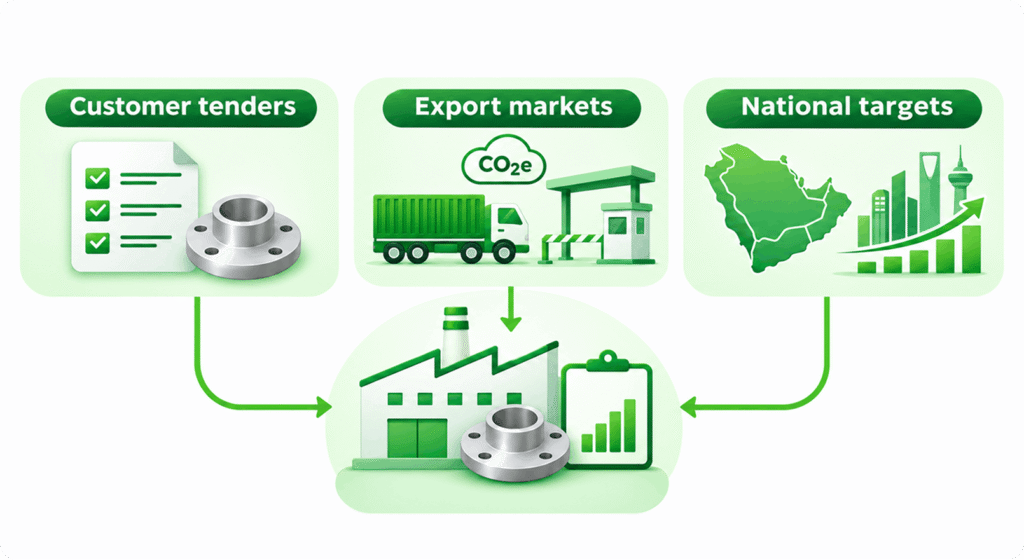
The Growing Importance Of The Carbon Footprint For GCC Manufacturers.
01
Customers and tenders want product-specific numbers
Procurement teams increasingly ask suppliers for the footprint of the exact product being purchased. A supplier that can provide a clear, consistent figure and explain how it was calculated is better positioned to respond than one that offers a general estimate. In competitive bids, the ability to provide relevant emissions data can influence supplier assessments. This is one of the clearest examples of the importance of the carbon footprint in day-to-day business.
For GCC manufacturers, this means preparing product information before a customer request arrives. Teams may need to gather material quantities, supplier information, manufacturing details and transport records from different departments. Without a defined process, even a straightforward request can turn into a time-consuming data collection exercise. Manufacturers that recognise the importance of the carbon footprint early are the ones that treat these requests as routine rather than urgent.
At Octscope, we focus on making this information easier to organise for product carbon footprint calculations. Our platform allows manufacturers to structure product inputs and associated transport details within reusable templates. This provides a consistent starting point when teams need to prepare or update product footprint reports.
The information required will vary depending on the customer’s methodology and reporting requirements. Manufacturers should therefore establish what a buyer expects, which product boundaries apply and whether independent verification is necessary before submitting a footprint.
02
Export markets are putting a price on embedded emissions
The European Union’s Carbon Border Adjustment Mechanism (CBAM) entered its definitive phase on 1 January 2026. Under this mechanism, businesses importing covered products into the EU must meet requirements based on the carbon emissions generated during their production. The mechanism covers six sectors: cement, iron and steel, aluminium, fertilisers, electricity and hydrogen. Importers must surrender the required CBAM certificates for goods imported in 2026 by 30 September 2027.
Gulf countries are also affected because they export large quantities of these products to Europe. In 2023, the UAE exported approximately $2.7 billion worth of CBAM-covered goods to the EU, followed by Bahrain at $1.3 billion, Saudi Arabia at $565 million and Oman at $400 million. Aluminium accounts for a major share of these exports, making its manufacturing emissions particularly important for Gulf producers.
Two details matter for manufacturers. First, importers may be able to use verified actual emissions data instead of default values, subject to the applicable CBAM rules. Default values can produce less favourable results in some circumstances. Second, the EU has proposed extending CBAM from 2028 to roughly 180 additional steel- and aluminium-intensive downstream products, mainly machinery and appliances. Manufacturers that do not directly produce cement or steel may still face requests from customers for emissions data about their products.
CBAM has specific calculation, documentation and verification requirements. A product carbon footprint is not automatically a CBAM declaration, and preparing a PCF alone does not establish regulatory compliance. However, the process of identifying product inputs, collecting supporting records and documenting calculation assumptions can help manufacturers prepare for emissions data requests.
At Octscope, we help manufacturers organise product inputs and transport details and generate a Product Carbon Emission Report in PDF format. This gives users a structured record of their product carbon footprint calculation. Whether the resulting information is suitable for a particular CBAM obligation depends on the applicable rules, calculation methodology, supporting evidence and verification requirements.
For businesses in the GCC, the practical lesson is to start organising product emissions data early. Waiting until an export customer requests information can leave teams with limited time to identify gaps, validate records and prepare the required documentation.
03
National agendas are raising expectations for products
The policy backdrop across the Gulf is moving towards greater attention to emissions measurement and reduction, and that attention increasingly reaches the products factories make.
Saudi Arabia: The Kingdom has announced a net-zero target for 2060 through its circular carbon economy approach, alongside the Saudi Green Initiative. Its interim ambition includes reducing emissions by 278 million tonnes annually by 2030. The net-zero target concerns domestic emissions and does not mean that exported hydrocarbons are included in the same way as domestic emissions.
The UAE: The country targets net zero by 2050.
These ambitions are set at national level, so they do not replace product-level calculations. What they do is raise the expectation that manufacturers can show the footprint of what they make.
At Octscope, our focus is on the product-level data that manufacturers need to prepare and maintain. By structuring product inputs and associated transport information, our platform helps users organise the information that supports product carbon footprint reporting.
For GCC manufacturers, building a repeatable process for product carbon footprint calculations can also make it easier to respond when customers introduce new sustainability questionnaires, procurement criteria or reporting expectations. The exact process will depend on the business, its products and the markets it serves.
What Vision 2030 Means For Manufacturers?
Three Key Factors Driving Product Carbon Footprint Adoption Across The GCC.

Industry is one of the pillars of Saudi Vision 2030. The National Industrial Strategy aims to triple industrial domestic product and double the value of industrial exports to reach SAR 557 billion by 2030. As Saudi manufacturers expand production and enter international markets, they may encounter more customers asking for product-level emissions information.
Sustainability is also part of the Kingdom’s industrial ambitions. Saudi Arabia’s Ministry of Industry and Mineral Resources has cited targets that include reducing industrial emissions by 22 million tonnes annually by 2030, alongside a shift from liquid fuels towards electricity and gas.
For manufacturers, the practical implication is that industrial growth and emissions management increasingly need to be considered together. Under Vision 2030, the importance of the carbon footprint grows in step with industrial output and export ambition. Businesses pursuing new export opportunities may need to demonstrate not only product quality and delivery capabilities but also how they measure and manage the environmental impact of their products.
At Octscope, we believe that preparing for this shift begins with making product data easier to organise and review. Manufacturing businesses already maintain records covering purchased materials, production quantities, suppliers and transportation. Bringing relevant information into a consistent product carbon footprint workflow can help connect these operational records with product carbon footprint reporting needs.
For example, a manufacturer producing the same item at multiple facilities may need to account for differences in material sourcing, input quantities or transport routes. A structured approach makes it easier to identify those differences and review the information used in each calculation. The resulting footprint still depends on complete data, suitable emissions factors and a clearly defined methodology.
As Vision 2030 continues to support industrial development and export growth, manufacturers can benefit from treating product carbon footprint measurement as part of their wider operational planning. Understanding the importance of the carbon footprint at this stage helps teams plan for it rather than react to it. Establishing a repeatable process now can help teams prepare for evolving customer expectations without assuming that every market or buyer will apply the same requirements.
Where GCC Manufacturers Get Stuck?
Common Data And Process Challenges In Product Carbon Footprinting.
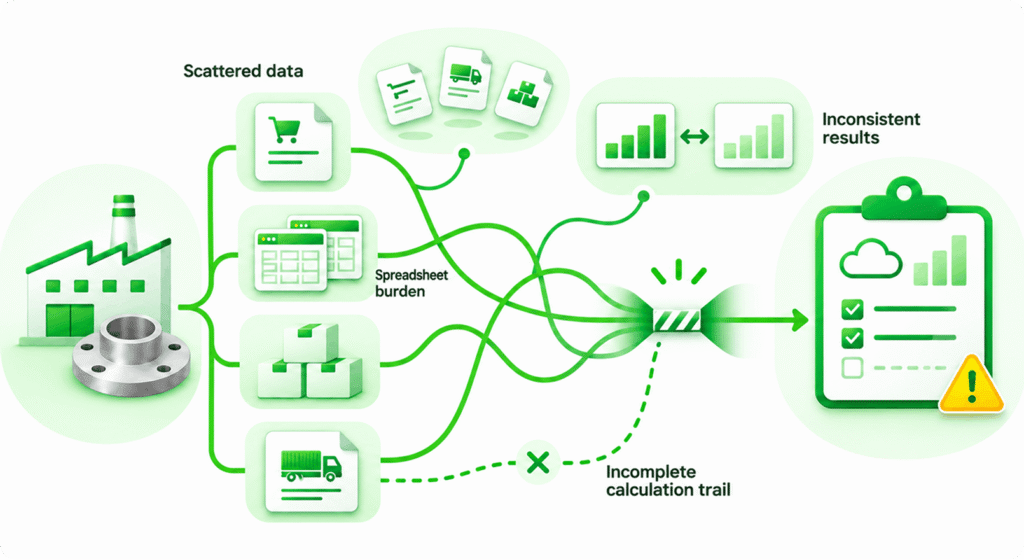
Most manufacturers already hold much of the data needed to calculate a product footprint. Purchase records, production data and transport details exist somewhere in the business. The challenge is bringing that information together and using it consistently.
01
The data is scattered
Purchasing, production, inventory and logistics information may sit in separate systems that were not designed for product-level carbon calculations.
02
Spreadsheets become difficult to maintain
One product can require multiple calculations when materials, suppliers, plants and transport routes vary. Repeating the process across many products increases the administrative burden.
03
Results are not always comparable
A figure calculated using one set of assumptions may not be comparable with a later result if the boundaries, emissions factors or methods have changed.
04
The calculation trail is incomplete
When a customer asks how a figure was reached, manufacturers need to identify the source data, assumptions and calculation method behind the result.
These challenges become particularly noticeable when a tender, customer request or audit arrives with a deadline.
At Octscope, we designed our product carbon footprint workflow around the need to organise product information in a structured format. Users can create product templates and bring in available data through data integrations, file uploads or manual entry. They can then record relevant inputs and transport details within that structure.
Reusable templates can help manufacturers maintain a more consistent process across products and reporting periods. Instead of rebuilding the same data structure every time, teams can work from a defined template and update the information relevant to the next calculation.
However, organising data is only one part of producing a reliable footprint. Manufacturers must still check whether the records are complete, whether the emissions factors are appropriate, and whether the chosen methodology matches the intended use. A structured workflow makes the process easier to manage, but it cannot replace data validation or independent verification when these are required.
What A Defensible Product Carbon Footprint Needs?
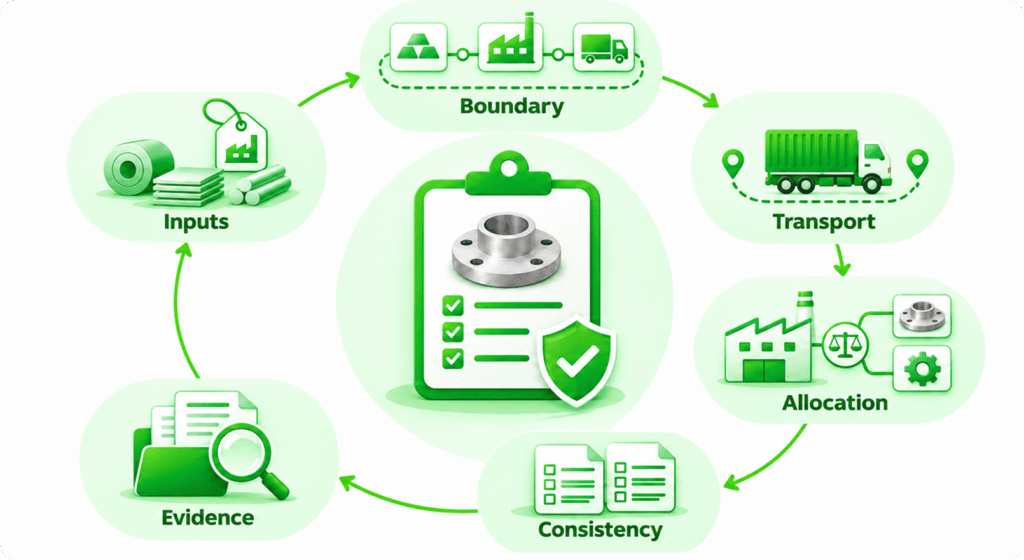
Essential Elements Of A Reliable Product Carbon Footprint.
A product carbon footprint is only as trustworthy as the method and information behind it. A result worth sharing should have several essential elements.
Every relevant input is identified
Each material or component included in the assessment should be recorded with its quantity and source. The calculation should distinguish internally produced inputs from externally sourced materials where that distinction affects the defined boundary.
The system boundary is clearly stated
Manufacturers need to specify which life-cycle stages are included, such as raw material production, manufacturing and transport. Internally produced inputs and externally sourced inputs must be treated consistently within the selected boundary to avoid omissions or double counting.
Transport data is recorded appropriately
Relevant transport modes, distances and input quantities should be documented for the transport stages included in the assessment. Estimates should be supported by reasonable assumptions and recorded transparently.
Defined co-product allocation method
When a manufacturing process produces more than one output, the emissions must be allocated using an appropriate method consistent with the applicable standard and assessment requirements.
The calculation method is consistent
Applying a documented approach across products and reporting periods helps manufacturers compare results meaningfully. Changes in data sources, emissions factors, boundaries or assumptions should be recorded.
Supporting evidence is retained
Source records and calculation assumptions should be available for review. Independent verification may also be necessary, depending on the intended use of the footprint.
At Octscope, we emphasise structured input collection because a credible result begins with knowing what information enters the calculation. Our product templates provide a way to organise details such as materials, sources, manufacturing locations, transport modes, distances and input quantities.
This structure helps manufacturers review the information used to prepare a Product Carbon Emission Report. It can also make missing information easier to identify before a result is shared with a customer or other stakeholder.
The next step is to ensure that the calculation itself follows an appropriate methodology. The choice of emissions factors, the treatment of co-products, the defined system boundary and the quality of the source data all affect the result. Manufacturers should document these decisions and check that their approach aligns with the relevant standard or customer requirement.
When these elements are addressed, a product carbon footprint becomes more than an unsupported claim. It becomes a calculation that can be explained, reviewed and used to inform business decisions.
How Does Octscope Help Manufacturers Calculate Product Carbon Footprints?
Octscope’s Approach To Product Carbon Footprint Calculation And Reporting.
Octscope is a product carbon footprint platform designed to help manufacturers organise product data and prepare PCF reports through a structured workflow.
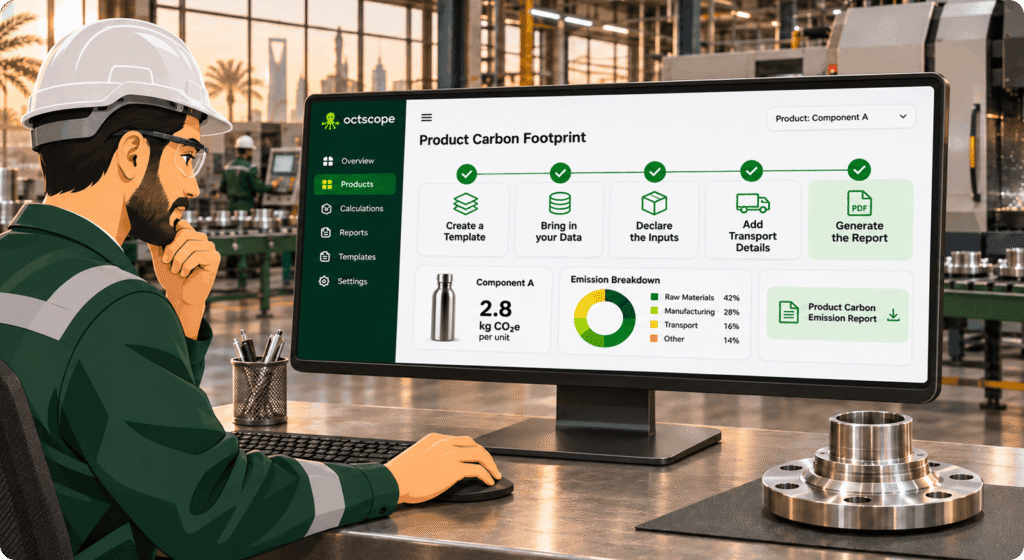
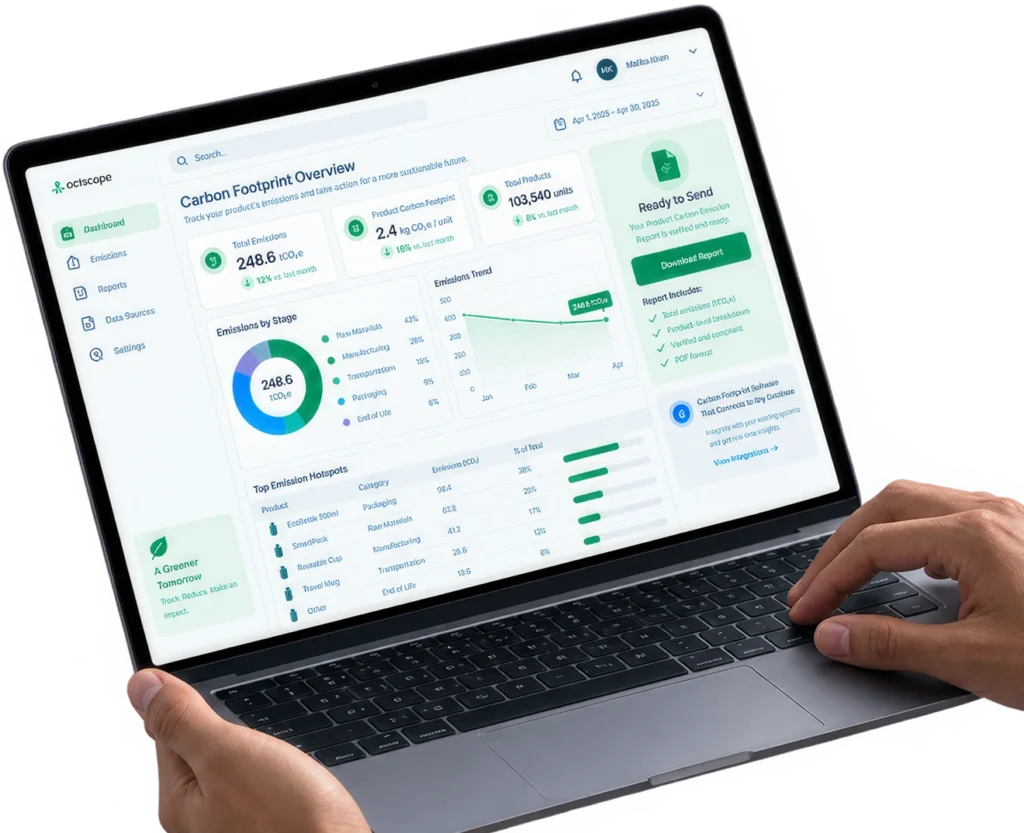
Users can create a template for a product, bring in available information through a database connection, file upload or manual entry, declare the relevant inputs, record associated transport details and generate a Product Carbon Emission Report as a PDF.
Because templates can be reused, manufacturers can build on an established data structure when working with another product or preparing an updated calculation. This can reduce the need to recreate the same input fields and workflow for every reporting cycle.
Octscope was built in Saudi Arabia and is designed for manufacturers globally, including businesses across the GCC that supply domestic and international markets. Our focus is on helping teams organise the information behind product carbon footprint calculations in a format they can review and use for reporting.
For example, a manufacturer can use a product template to organise material quantities and relevant transport information before generating a report. When the product or its supply chain changes, the manufacturer can review the affected inputs and update the information used in the next calculation. The accuracy of the resulting footprint depends on the completeness of the records, the suitability of the emissions factors and the calculation method applied.
We also recognise that different reporting purposes come with different requirements. A report prepared for internal analys reducing carbon footprint in the workplaceis may not satisfy a customer’s verification requirements or a regulatory declaration. Manufacturers should confirm the applicable methodology, supporting documentation and assurance requirements before using a footprint for a specific compliance purpose.
For GCC manufacturers preparing for changing customer expectations, export requirements and national sustainability ambitions, a structured approach to product carbon footprint calculations can be a useful step towards better emissions visibility. Recognising the importance of the carbon footprint at product level is what makes that visibility worth building.
The goal is not simply to generate a number. It is to understand the product information behind it, apply a consistent calculation method and communicate the result appropriately.
Conclusion
The importance of the carbon footprint for GCC manufacturers is no longer a matter for an annual sustainability report. It now shows up in everyday commercial decisions: a tender that asks for the footprint of a specific product, an export market that attaches a cost to embedded emissions, and national strategies such as Vision 2030 that tie industrial growth to emissions management.
Meeting these expectations takes more than producing a single number. A defensible product carbon footprint rests on clearly identified inputs, a stated system boundary, properly recorded transport data, a defined co-product allocation method, a consistent calculation approach and retained supporting evidence. Most manufacturers already hold much of this data, but it is often scattered across systems and hard to keep consistent in spreadsheets.
This is where a structured workflow helps. Octscope lets manufacturers build reusable product templates, bring in data through database connections, file uploads or manual entry, record inputs and transport details, and generate a Product Carbon Emission Report as a PDF. Data validation, suitable emissions factors and independent verification remain essential where a customer or regulation requires them.
Manufacturers that recognise the importance of the carbon footprint early can answer customer and export requests with confidence rather than scrambling when a deadline arrive.
Ready to organise your PCF data?
Explore Octscope to learn how structured product templates and reporting can support your product carbon footprint workflow.
Frequently Asked Questions
Why does the product carbon footprint matter for GCC manufacturers?
The importance of the carbon footprint for GCC manufacturers comes from three pressures: customers and tenders asking for product-specific numbers, export markets putting a price on embedded emissions, and national agendas raising expectations that manufacturers can show the footprint of what they make.
How does Saudi Vision 2030 affect product carbon footprints?
Industry is a pillar of Vision 2030, and the National Industrial Strategy targets growth in industrial output and exports. As manufacturers enter more international markets, they may face more customers asking for product-level emissions information.
What does a defensible product carbon footprint need?
It needs six things: every relevant input identified, a clearly stated system boundary, appropriately recorded transport data, a defined co-product allocation method, a consistent calculation method, and retained supporting evidence.
Why is it hard to calculate a product carbon footprint with spreadsheets?
One product can need multiple calculations when materials, suppliers, plants and transport routes vary. Spreadsheets also make it harder to keep results comparable and to maintain a clear calculation trail when a customer asks how a figure was reached.
Can Octscope handle products made at multiple facilities?
A product template lets you organise material sourcing, input quantities and transport routes, which makes differences between facilities easier to identify and review. The resulting footprint still depends on complete data, suitable emissions factors and a clearly defined methodology.
Can I send an Octscope report to a customer or auditor?
Octscope generates a Product Carbon Emission Report as a PDF, giving you a structured record of the calculation. Whether it satisfies a specific customer, verification or regulatory requirement depends on the applicable methodology, supporting evidence and assurance requirements, so confirm these first.
Does Octscope work for manufacturers outside Saudi Arabia?
Yes. Octscope was built in Saudi Arabia and is designed for manufacturers globally, including businesses across the GCC that supply domestic and international markets.
How do I get started with Octscope?
Explore Octscope and start by creating a template for one product, then add its inputs and transport details and generate your first Product Carbon Emission Report.