
What Is A Carbon Footprint? Understanding Product Carbon Footprints
In this article
You can’t reduce what you can’t trace.
Start with the product data you already have.
Every product carries emissions, from the raw materials that go into it to the day it reaches the customer. If you’re wondering what is a carbon footprint, it refers to the total emissions associated with a product, expressed in carbon dioxide equivalent (CO₂e). For a product, it covers the emissions generated during the use of raw materials, manufacturing, and transportation. This is called the product carbon footprint, or PCF.
A PCF is usually shown as one number per unit: kg CO₂e per bottle, per cable, per panel, per tonne of steel. That single number is only useful if you can explain how it was built.
At Octscope, we help manufacturers organise product-level data, including material inputs, sourcing details, production locations, and transport information, to support product carbon footprint calculations. Our structured workflow helps bring these inputs together and generate a Product Carbon Emission Report, giving teams a clearer view of the data behind their product’s footprint.
This guide covers what is a carbon footprint, the types of product carbon footprint, how a PCF is calculated, and why it has become the number manufacturers are increasingly asked for.
What Is A Carbon Footprint?
Understanding Carbon Footprints Through Octscope’s Manufacturing Experience.
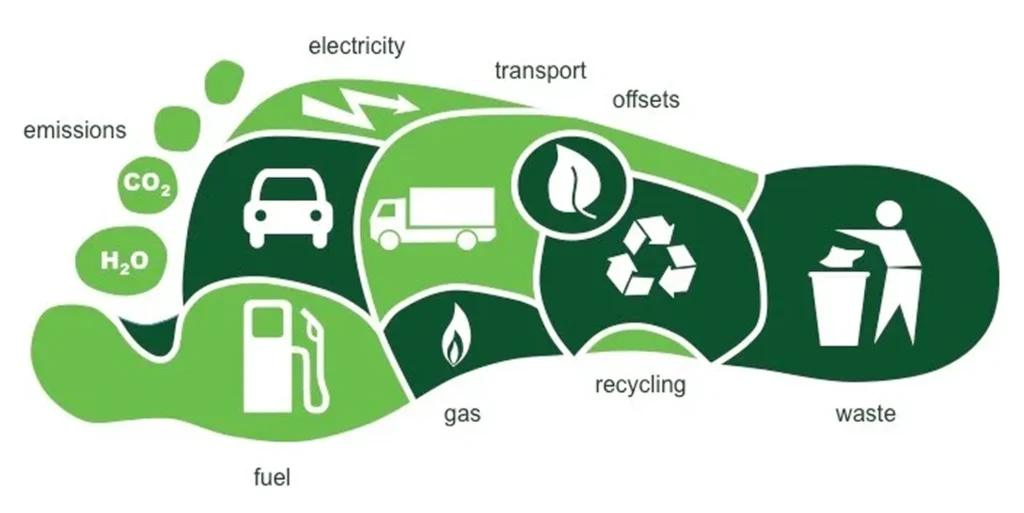
A carbon footprint refers to the total amount of emissions, measured in carbon dioxide equivalent (CO₂e), that are linked to an activity or an item. This is what is meant by a carbon footprint: a measurement of the emissions associated with a product, activity, or process. The word “carbon” is shorthand. The measure covers carbon dioxide and other heat-trapping gases, such as methane and nitrous oxide.
The inputs
The materials and components that go into the product.
The sources
Whether each input was produced internally or sourced from outside.
The transport
For externally sourced inputs, the mode and distance travelled.
These gases do not all warm the planet equally, so each is converted into the amount of CO₂ that would have the same effect. That is the CO₂e unit. Methane, for example, traps far more heat per kilogram than CO₂, so 1 kg of methane counts as roughly 27 to 30 kg CO₂e. Converting everything to CO₂e gives one number that can be compared across products, materials, and suppliers.
At Octscope, we see why this matters first-hand. Our team has spent years building software for manufacturers and industrial clients in the GCC, and the same problem kept coming up: product data scattered across systems, with no easy way to turn it into a reliable footprint. That experience is why Octscope calculates emissions at the product level, and why every number it produces is meant to be traceable back to the input, the source, and the transport behind it.

What Is A Product Carbon Footprint (PCF)?
Understanding Product Carbon Footprint and Its Scope.
A product’s carbon footprint refers to the CO₂e associated with one product, calculated from the inputs that went into it and the transport that moved them. It answers three practical questions:
How much CO₂e does one unit of this product carry?
Which materials, processes, or transport legs contribute most?
Where did each number come from?
Product footprints follow recognised standards. ISO 14067 sets out requirements for quantifying the carbon footprint of a product, and it builds on life cycle assessment principles from ISO 14040 and ISO 14044.
Octscope applies a product-level approach by organising information about materials, sourcing, production locations, and transport within a defined workflow. Its product templates help manufacturers structure the data associated with individual products and generate a Product Carbon Emission Report. The reliability of the resulting footprint depends on the selected boundary, the quality of the underlying data, and the methodology and emission factors applied.
What Are The Types of Product Carbon Footprint?
Product Carbon Footprint Types Based on Lifecycle Boundaries.
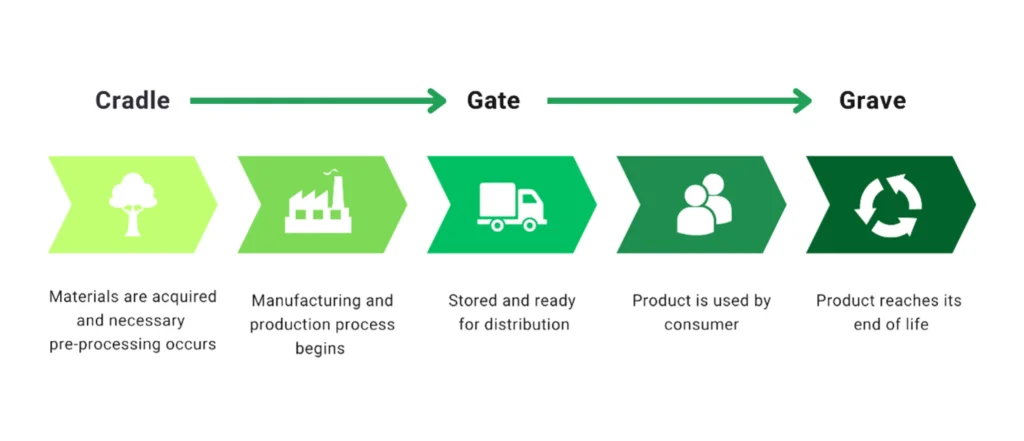
Knowing what is a carbon footprint also means understanding which stages of a product’s life cycle are included in the calculation. Product footprints are grouped by boundary: how much of the product’s life the calculation covers. The boundary has to be stated alongside the number, because the same product gives different results under different boundaries.
Type
Cradle-to-gate
what it covers
Raw material extraction through manufacturing, up to the factory gate
when its used
The most common PCF for materials and components sold to other manufacturers
Type
Gate-to-gate
what it covers
Only the manufacturing step inside one facility
when its used
Understanding the impact of a single production process
Type
Cradle-to-grave
what it covers
The full life: materials, manufacturing, transport, use, and end-of-life
when its used
Finished goods where use and disposal matter
Transport can sit inside relevant boundaries, depending on the assessment scope. Moving inputs to the factory and moving the finished product to the customer can add emissions, so a transparent PCF documents which transport legs are included rather than presenting a total without context.
When building a product footprint in Octscope, manufacturers organise the product’s inputs and associated transport details within a structured template. Defining the boundary before collecting data helps ensure that the resulting calculation reflects the intended scope and can be interpreted correctly by customers, procurement teams, and other stakeholders.
What Makes Up A Product's Carbon Footprint?
Key Components Included in a Product Carbon Footprint.
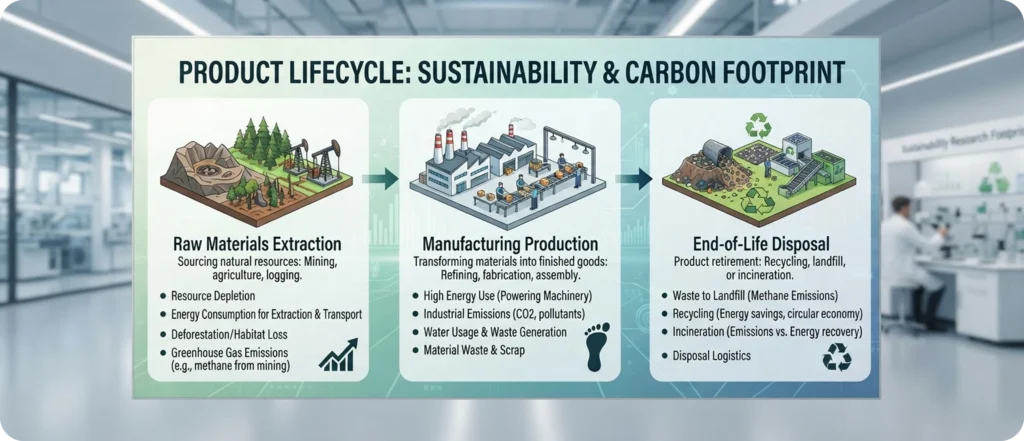
01
Product lifecycle boundaries
The emissions embedded in everything that goes into the product, which is often the largest share.
02
Manufacturing
The energy and processes used to turn inputs into the finished product.
03
Packing
The material used to protect and ship the product.
04
Transport
Every movement of inputs and finished goods included within the chosen boundary, by road, sea, rail, or air
05
Use and end of life
Included in cradle-to-grave footprints: energy used by the product, and what happens when it is recycled or discarded.
For manufacturers, identifying these components means understanding which data is needed before the calculation begins. This is the practical side of what is a carbon footprint: knowing which inputs count and where their data lives. Octscope structures product inputs and transport information in its workflow, helping manufacturers organise relevant records and see how these details contribute to the product footprint.
The information required will vary according to the product and its assessment boundary. For example, a manufacturer calculating a cradle-to-gate footprint may focus on materials, production, and inbound transport, while a cradle-to-grave assessment may also require data about product use and disposal.
Calculate Your Product's Carbon Footprint
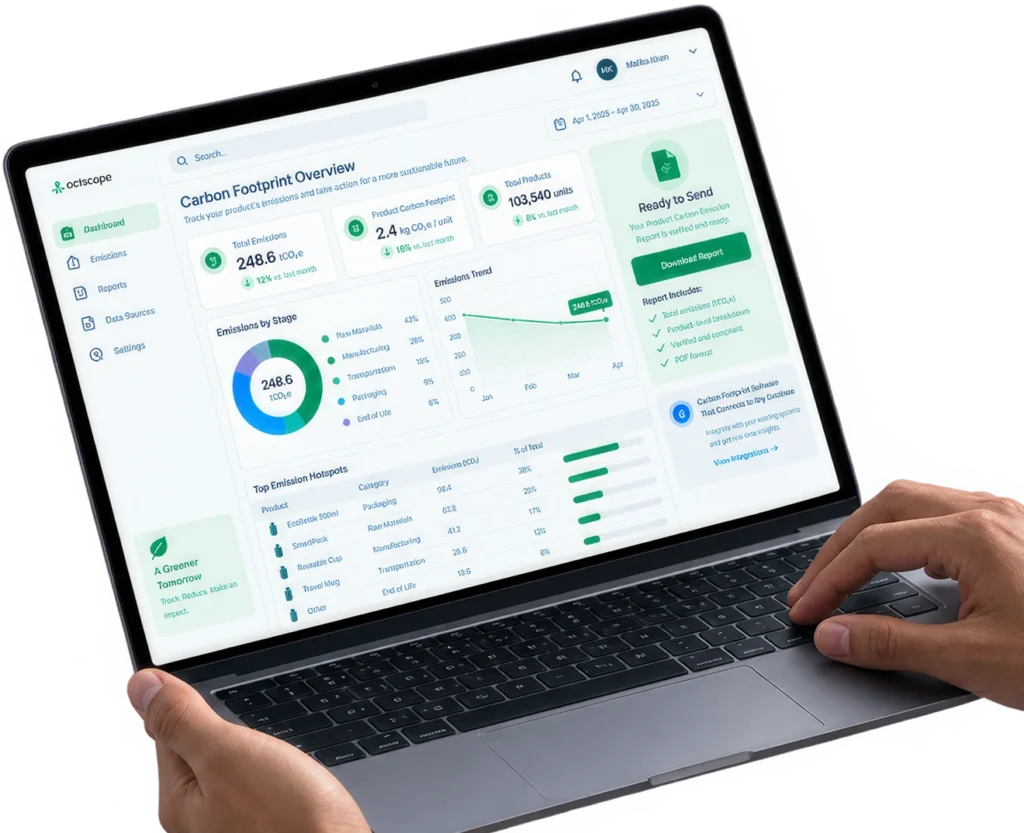
Get a ready-to-send, verified Product Carbon Emission Report.
Why does PCF Matter?
Importance of Product Carbon Footprints for Manufacturers.
A product footprint turns a vague sustainability goal into something specific and checkable. Knowing what is a carbon footprint is the first step; knowing what makes it useful is the second. Understanding what is a good carbon footprint depends on the product, its function, the assessment boundary, and comparable benchmarks. A lower figure alone does not necessarily mean a footprint is good. Manufacturers need to compare products using consistent methodologies, suitable emission factors, and clearly documented assumptions.
It shows where the emissions are
A PCF breaks one product’s footprint down by material, process, and transport leg. You can see whether the biggest contributor is a raw material, a production step, or the shipping route, and focus there.
Octscope’s product-level approach helps manufacturers organise the input and transport information behind their calculations. The usefulness of this breakdown depends on collecting sufficiently detailed activity data and applying appropriate emission factors.
Buyer are asking for it
Manufacturers who purchase your product need its footprint to calculate their own. If you supply materials or components, your PCF becomes part of their numbers, and increasingly part of how they choose suppliers.
Two materials, two suppliers, or two sourcing routes can be compared properly once each has a footprint calculated the same way. Without one, the comparison is a guess.
Octscope’s reusable product templates support consistent data organisation across reporting cycles. Meaningful comparisons still require compatible boundaries, methods, emission factors, and assumptions, with any material differences documented.
It makes comparison possible
Two materials, two suppliers, or two sourcing routes can be compared properly once each has a footprint calculated the same way. Without one, the comparison is a guess.
Octscope’s reusable product templates support consistent data organisation across reporting cycles. Meaningful comparisons still require compatible boundaries, methods, emission factors, and assumptions, with any material differences documented.
It holds up scrutiny
A footprint traceable to its inputs, sources, and transport can be explained to a customer, auditor, or regulator. A rough estimate often cannot.
Octscope is designed to organise product inputs, sourcing information, and transport details within a defined workflow, helping manufacturers maintain a clearer record of the information behind a reported figure. The degree of verification or assurance a footprint can withstand depends on the completeness of its evidence, the calculation methodology, and any independent review required.
It’s a baseline for reduction
You can only measure improvement against a number you trust. Swapping a material or changing a route is easier to evaluate once the starting point is clear.
By bringing product-level data together, Octscope helps manufacturers establish a basis for investigating potential improvement areas. Actual emissions reductions depend on the changes implemented and must be assessed using comparable calculations. Read more about reducing the carbon footprint in manufacturing.
How Octscope Approaches Product Carbon Footprints?
Octscope’s Core Principles and Platform Capabilities.
Octscope is a product carbon footprint platform designed to help manufacturers organise and calculate the emissions associated with making and moving a product. Product information can be connected through data integrations, uploaded, or entered manually. The platform generates a Product Carbon Emission Report based on the information recorded in the workflow.
Three principles shape its approach:
Transparency over black boxes
Product inputs, sourcing details, and transport information are organised within a structured workflow, helping manufacturers trace the information behind their calculations.
Built to reuse, not rebuild
Product templates can be reused across reporting cycles, reducing the need to recreate the product structure each time. Manufacturers should still review updated data, methods, and assumptions for each new assessment.
Designed for manufacturers beyond its home market
Octscope is designed to support manufacturers working with production, purchasing, and transport data across different markets. Its product-level approach helps businesses organise the information associated with individual products and maintain a consistent structure for carbon footprint calculations.
Octscope’s workflow includes product templates, input declarations, sourcing details, transport information, and PDF report generation. These capabilities help manufacturers organise the information required for product carbon footprint measurement without relying entirely on disconnected spreadsheets.
The aim is to move from estimating to calculating: a footprint you can trace, explain, and stand behind. The strength of the final result depends on the quality of the underlying data, the suitability of the emission factors, the chosen boundary, and the methodology used.
Conclusion
What is a carbon footprint? It is the emissions associated with a product, activity or process, measured in CO₂e. For manufacturers, that means understanding the emissions of their products, from raw materials and manufacturing to transport and, where relevant, product use and end-of-life. A product carbon footprint (PCF) turns this information into a measurable figure that can help identify emission hotspots, compare alternatives, and track changes over time.
The challenge lies in building a footprint from data that is complete, traceable, and calculated using a consistent methodology. Without a clear record of inputs, emission factors, and calculation boundaries, even a single CO₂e figure can be difficult to explain or compare.
Octscope helps manufacturers organise product inputs, sourcing information, and transport details within a structured workflow and generate Product Carbon Emission Reports. By bringing these records together, manufacturers can establish a clearer starting point for understanding product emissions and identifying opportunities for improvement.
Calculate Your Product's Carbon Footprint
Start building a more traceable product carbon footprint with Octscope and turn scattered product data into actionable emissions insights.
Frequently Asked Questions
What are the main types of product carbon footprint?
The three commonly used product life-cycle boundaries are cradle-to-gate, gate-to-gate, and cradle-to-grave. Cradle-to-gate covers raw materials through manufacturing, gate-to-gate focuses on a specific production stage, and cradle-to-grave covers the product’s life through use and end-of-life.
What is the difference between cradle-to-gate and cradle-to-grave?
Cradle-to-gate measures emissions from raw material extraction through manufacturing up to the factory gate. Cradle-to-grave extends the assessment to include the product’s use and end-of-life stages. The appropriate boundary depends on the product and the purpose of the assessment.
Why is product carbon footprint data difficult to manage in manufacturing?
Manufacturing data is often spread across purchasing systems, production records, supplier files, and logistics platforms. Inconsistent formats, missing information, generic emission factors, and repeated spreadsheet calculations can make footprints difficult to trace and compare. A structured workflow helps organise these records and identify data gaps.
Can Octscope work with existing manufacturing data?
Octscope supports multiple ways to bring product information into its workflow, including supported database connections, file uploads, and manual entry. Manufacturers can begin with available records and map relevant information to product template fields rather than waiting for every data source to be integrated.
What does an Octscope Product Carbon Emission Report include?
The report brings together recorded product information, including inputs, sourcing and transport details, plants in scope, the reporting period, and applicable co-products. Its contents depend on the information entered and the platform’s configured reporting workflow.
Can Octscope help compare product carbon footprints over time?
Octscope’s reusable product templates help manufacturers maintain a consistent structure across reporting cycles. Meaningful comparisons also require compatible calculation boundaries, methods, emission factors, and assumptions, with changes documented where necessary.
How can manufacturers get started with Octscope?
Manufacturers can start by selecting a product, defining its assessment boundary, and identifying where its material, sourcing, production, and transport data are stored. They can then organise the available information using Octscope’s product workflow and generate a Product Carbon Emission Report based on the recorded data. For platform-specific onboarding or a demonstration, contact the Octscope team through its official website.